棫
Character Story & Explanation
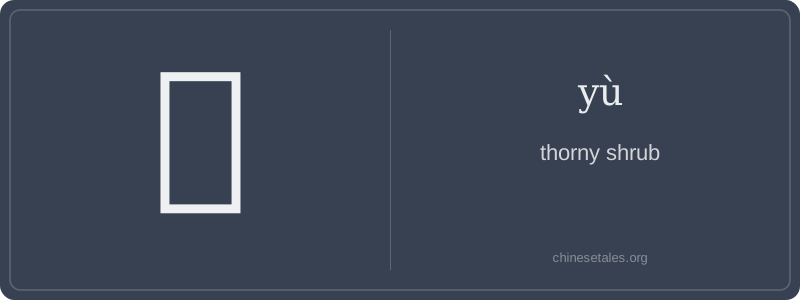
The earliest form of 棫 appears in bronze inscriptions as a composite pictograph: a simplified tree (木) on the left, paired on the right with a stylized representation of a walled enclosure or territory (originally 域 without the soil radical 土). Over centuries, the right side evolved from a full 域 into the streamlined 域-like shape we see today — retaining the ‘yù’ sound but losing its literal ‘boundary’ meaning. The original idea may have been ‘the shrub that grows at the edge of the domain’ — a hardy, thorny marker plant used to demarcate land or deter intruders, hence its prickly nature embedded in both form and function.
By the Warring States period, 棫 was firmly established in the Shijing (Book of Odes), appearing in the line ‘柞棫斯拔,松柏斯兑’ — describing the clearing of wild shrubs (like 棫 and 柞) to make way for noble pines and cypresses. Here, 棫 symbolizes untamed, humble vegetation — contrasted with cultivated, auspicious trees. Its visual structure — wood + territory — quietly reinforces this: not just any shrub, but one that belongs to a place, rooted in local ecology and human spatial practice. Even today, its shape whispers ‘wood that defines where you stand’.
At first glance, 棫 (yù) feels like a linguistic fossil — a character that’s almost never heard in modern speech or seen outside classical texts, dictionaries, or botanical glossaries. It names a specific thorny shrub (possibly Vitex negundo or a related species), but unlike common plant characters like 桃 (peach) or 竹 (bamboo), 棫 carries no culinary, poetic, or symbolic weight in everyday life. Its ‘feel’ is scholarly, quiet, and slightly prickly — much like the plant itself: unassuming, hard to pronounce correctly (many misread it as yì or yú), and easy to overlook.
Grammatically, 棫 functions exclusively as a noun — never a verb, adjective, or measure word — and almost always appears in compound nouns or descriptive phrases, rarely alone. You’ll find it in classical botanical lists (e.g., 棫、柞、棫、樸 — all ancient tree/shrub names in the Shijing), or in rare modern compound terms like 棫朴 (yù pǔ), where it evokes antiquity and rustic simplicity. Learners attempting to use it conversationally will likely draw blank stares — not because it’s ‘wrong’, but because it’s functionally obsolete in spoken Chinese, like using ‘thorn-apple’ instead of ‘jimsonweed’ in English.
Culturally, 棫 reveals how deeply Chinese lexicography values precision *and* preservation: even obscure, regionally limited plant names were codified in bronze-age texts and maintained across millennia — not for daily utility, but for textual fidelity, ritual accuracy, and cosmological completeness. A common mistake? Assuming it’s related to 易 (yì, ‘easy’) or 木 (mù, ‘tree’) alone — but its radical is actually 木, and its phonetic component is 域 (yù, ‘territory’), hinting at an ancient association with boundary-marking shrubs.