缄
Character Story & Explanation
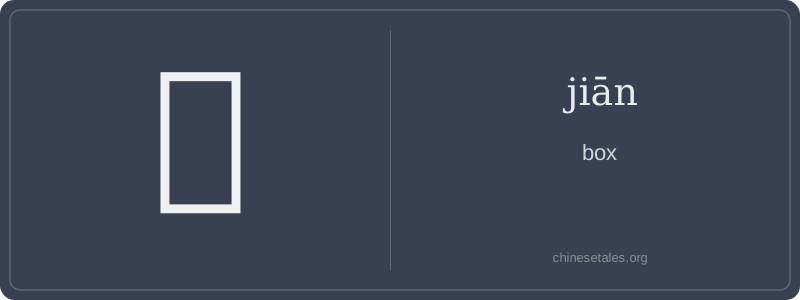
The earliest form of 缄 appears in bronze inscriptions from the Western Zhou dynasty (c. 1046–771 BCE), where it depicted a silk thread (the precursor to the 纟 radical) wrapping tightly around a rectangular object — likely a bamboo slip case or document pouch. Over centuries, the 'object' simplified into 又 (yòu, 'again/hand'), symbolizing the act of securing, while the silk threads evolved into the three-thread 纟 radical on the left — visually echoing the binding action. By the Han dynasty, the structure solidified into today’s 12-stroke form: 纟 + 又 + 咸, with 咸 (xián) serving as the phonetic component (though pronunciation shifted from xián to jiān).
This evolution reflects a profound semantic shift: from a literal 'sealed container' to the abstract 'act of sealing'. In the Zuo Zhuan, officials are described as '缄其辞' — 'sealing their words' — meaning withholding counsel out of prudence. Later, in Tang poetry, 缄 became synonymous with emotional restraint: Li Bai wrote of '缄情寄瑶瑟' ('sealing feeling into a jade zither'), transforming physical closure into lyrical reserve. The character’s very shape — threads coiling around speech — makes silence feel tactile, deliberate, and culturally virtuous.
Despite its dictionary definition as 'box', 缄 is almost never used in modern Mandarin to mean a physical container — that’s the job of 盒 (hè) or 箱 (xiāng). Instead, 缄 carries an elegant, literary weight: it means 'to seal' — especially letters, documents, or silence itself. It evokes discretion, formality, and quiet authority. When you see 缄 on an official envelope, it’s not just 'box' — it’s a visual promise: 'this message is sealed, unopened, confidential.' The character feels hushed, dignified, like a librarian’s finger to her lips.
Grammatically, 缄 functions almost exclusively as a verb in formal or written contexts, often in compound verbs like 缄口 (jiān kǒu, 'to seal one’s mouth') or 缄默 (jiān mò, 'to remain silent'). It rarely stands alone — you won’t hear someone say '我缄了' colloquially. Learners sometimes mistakenly use it as a noun ('a box'), but that usage vanished over 2,000 years ago; today, using 缄 for 'box' would sound like quoting ancient ritual texts at a coffee shop — charmingly archaic, but deeply confusing.
Culturally, 缄 reveals how Chinese values encode ethics in verbs: sealing isn’t just physical — it’s moral restraint. To 缄 your mouth isn’t suppression; it’s self-discipline, respect for hierarchy, or tactful omission. A common mistake? Confusing it with 简 (jiǎn, 'simple') — they sound alike and share the 'jian' sound, but 简 is open and light, while 缄 is closed and solemn. This contrast mirrors a deeper cultural rhythm: simplicity invites engagement; sealing honors boundaries.