椸
Character Story & Explanation
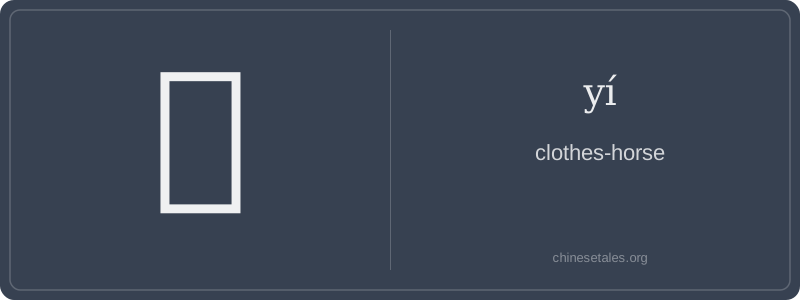
The earliest form of 椸 appears in late Warring States bamboo slips — not oracle bones — as a composite glyph: left side 木 (mù, 'tree/wood'), right side 肙 (yǐn, an archaic variant of 'to draw out' or 'extend'). The original seal script (篆书) shows three parallel horizontal strokes atop two verticals on the right, evoking arms stretched outward from a central post — a literal pictograph of a drying frame’s symmetrical, branching limbs. Over centuries, 肙 simplified into 以 (yǐ), then further stylized to the current + 人-like shape — losing its phonetic clarity but preserving the visual echo of extended arms.
By the Han dynasty, 椸 was codified in dictionaries like the Shuōwén Jiězì as 'a wooden frame for hanging clothes, shaped like a person with arms wide'. Its meaning never broadened — unlike many characters that drifted semantically, 椸 stayed stubbornly precise. In Bai Juyi’s Tang poem 'Buying Hemp Cloth', he writes '晒椸上青衫薄' (shài yí shàng qīng shān bó), describing indigo-dyed robes drying on the 椸 — underscoring its role in textile maintenance among scholar-officials. Even today, antique collectors use 椸 to authenticate Ming-Qing furniture catalogs, where its presence signals elite domestic aesthetics rather than mere function.
Think of 椸 (yí) as China’s answer to the Victorian clothes-horse — not the folding wire kind you see in dorm rooms, but the elegant, freestanding wooden frame that quietly held silk robes to air in Qing dynasty courtyards. It’s a noun, pure and simple: no verb forms, no adjectival uses, no common colloquial shortenings. You’ll almost never hear it in spoken Mandarin today — it’s a literary relic, like 'whence' or 'hither' in English — surviving mostly in classical poetry, antique inventories, or museum labels. Its tone is level (yī), but don’t let that fool you: mispronouncing it as yǐ (rising) or yì (falling) won’t trigger confusion — because most native speakers haven’t uttered it since middle school literature class.
Grammatically, 椸 behaves like a concrete count noun: it takes measure words like 架 (jià, for framed objects) or 只 (zhī, for slender upright things), as in 一架椸 (yī jià yí). You won’t say *椸了 to mean 'clothes-horsed' — it has zero verbal derivations. Learners sometimes force it into modern contexts ('I hung my shirt on the 椸'), but native speakers would just say 衣架 (yījià) — a far more natural, universally understood term. That’s the first trap: using an archaic word where a living one exists.
Culturally, 椸 evokes quiet domestic order — not utility, but ritualized care for fine textiles. In Tang dynasty poetry, it appears alongside incense burners and lacquered chests, symbolizing genteel household management. Modern learners often over-index on its 'wood' radical (木) and assume it’s broadly about 'wooden things', but 椸 is hyper-specific: only the freestanding, multi-armed drying frame — never a hanger, peg, or shelf. Confusing it with general terms like 架 or 柜 is like calling a harpsichord 'a piano' — technically wood-based, but historically and functionally distinct.