椽
Character Story & Explanation
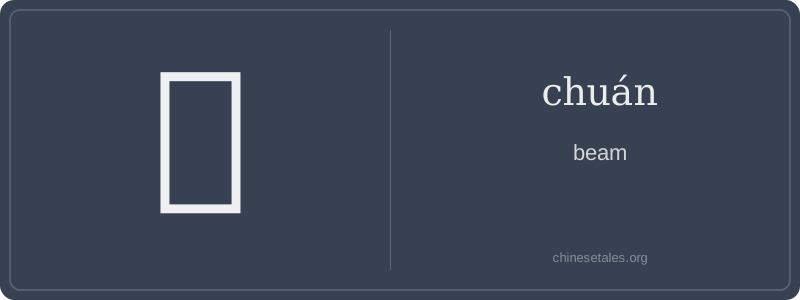
The earliest form of 椽 appears in Warring States bamboo slips — not as a pictograph, but as a phonosemantic compound already. Its left side 木 (mù, 'tree/wood') anchors meaning; the right side original was 彖 (tuàn), an ancient graph representing a 'cutting tool' or 'sectioned pattern', later simplified to 专 (zhuān) for sound. Over centuries, 专 evolved into the modern 专 component — three horizontal strokes above a 'crossed legs' shape (the 丨 and 亅 under the top strokes), visually echoing the parallel lines of rafters laid across a roof frame. By the Han dynasty clerical script, the character had stabilized: wood + rhythmic repetition = functional wood members in orderly sequence.
This visual rhythm mirrors its semantic evolution: from 'wood cut to standard length' to 'uniform supporting members'. In the Classic of Poetry (Shījīng), 椽 appears in odes praising ancestral halls — 'The rafters gleam, polished by generations' — linking craftsmanship to filial piety. Later, in Song-dynasty architecture manuals like Yingzao Fashi, 椽 became a technical term with precise measurements: 'eight-inch spacing, two-inch thickness'. The character’s very structure — repetitive strokes atop a stable base — silently enacts its function: many small parts, aligned, bearing shared weight.
At first glance, 椽 (chuán) feels like a quiet, architectural word — it means 'rafter' or 'roof beam,' the slender wooden members that support tiles in traditional Chinese buildings. But don’t mistake its modesty for simplicity: this character embodies a deep cultural reverence for structural integrity and hidden craftsmanship. In classical texts, 椽 rarely appears alone; it’s always part of a system — paired with 梁 (liáng, main beam), 檩 (lǐn, purlin), or 椽子 (chuán·zi, colloquial 'rafter'). Its presence signals not just wood, but *intentional load-bearing harmony* — a subtle reflection of how Chinese thought values interdependence over individual prominence.
Grammatically, 椽 is almost never used without a classifier (e.g., 一根椽, yī gēn chuán) or as part of a compound. Learners often wrongly treat it like a generic 'beam' (confusing it with 梁 or 柱), but 椽 is specifically horizontal, thin, closely spaced, and roof-specific — you’d never call a skyscraper’s steel girder a 椽. It’s also nearly always plural in practice: ancient poems speak of ‘hundreds of rafters’ (百椽), emphasizing collective function. Even today, in restoration work or rural architecture discussions, 椽 carries quiet authority — it’s the unsung hero holding up the sky.
Culturally, 椽 is a silent witness to China’s timber-framed tradition — where no nails were needed, only precise joinery. Mispronouncing it as chuǎn (like 喘, 'to pant') is a common slip that makes native speakers wince — imagine saying 'I’m panting the rafter!' A bigger trap? Assuming it’s interchangeable with 柱 (zhù, pillar). Nope: 柱 stands *up*, 椽 lies *flat* — one bears weight vertically, the other distributes it horizontally. Confuse them, and your mental blueprint collapses.