楋
Character Story & Explanation
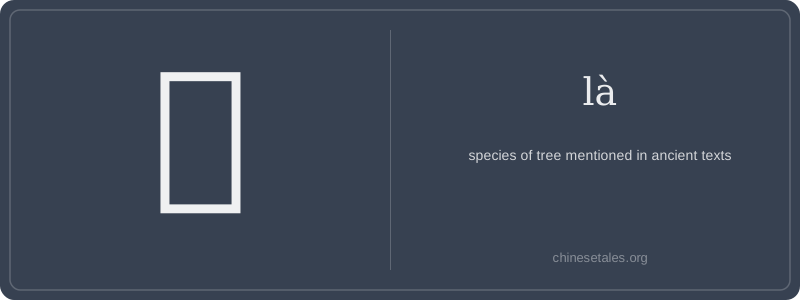
The earliest form of 楋 appears on Warring States bamboo slips — not oracle bones — as a compound ideograph: the left side was 木 (mù, 'tree'), clearly recognizable even then; the right side was a stylized phonetic component, likely derived from the ancient character 來 (lái), which originally depicted wheat stalks with drooping ears. Over centuries, 來 simplified and rotated, losing its grain-like curves and gaining angular strokes — eventually becoming the modern 又 (yòu) shape you see today, though it bears no semantic relation to 'again'. This phonetic shift masked the original sound link, leaving 楋 sounding like là instead of lái.
In the Shijing (c. 11th–7th c. BCE), 楋 appears in odes describing royal forests and sacrificial groves — notably in ‘Da Ya’ section, where it’s paired with 樗 (chū, 'wild catalpa') to evoke resilience amid neglect. Later commentators like Guo Pu (276–324 CE) identified it as a fast-growing, shade-providing tree used for coffins and ritual vessels — linking its wood’s durability to ancestral reverence. Visually, the contrast between the sturdy 木 radical and the compact, almost clenched 又 on the right mirrors this duality: rooted tradition meeting condensed, cryptic history.
Here’s the truth: 楋 (là) isn’t a character you’ll need to order dumplings or book a train ticket — it’s a linguistic fossil, preserved in classical texts like a pressed leaf between the pages of the Shijing (Book of Odes). Its meaning — a specific, now-uncertain species of deciduous tree, possibly related to the catalpa or paulownia — evokes how early Chinese thought embedded botany into cosmology: trees weren’t just plants; they were metaphors for virtue (upright trunks), longevity (deep roots), and ritual propriety (timely flowering). You won’t hear it in modern speech, but when you encounter it in classical poetry or historical botanical commentaries, it signals deep textual literacy — not vocabulary fluency.
Grammatically, 楋 functions strictly as a noun — never a verb, adjective, or measure word. It appears almost exclusively in fixed, literary compounds like 楋木 (là mù, 'the là-tree') or in parallel poetic lines: '樠松柏兮' — where its presence balances rhythm and allusion, not semantics. Learners sometimes misread it as là (to fall) or là (to pull), but this 楋 has zero functional overlap with those homophones — no grammar rules apply, no derivations exist. It’s a lexical island.
Culturally, its obscurity is the point: characters like 楋 reveal how Chinese writing preserves ecological memory — names for trees that may no longer grow in certain regions, or whose identity scholars still debate. A common mistake? Assuming it’s ‘just another tree character’ like 松 (pine) or 柏 (cypress) and trying to use it conversationally. Don’t. It’s not archaic — it’s *archival*. Respect it like a museum label, not a vocabulary card.