楸
Character Story & Explanation
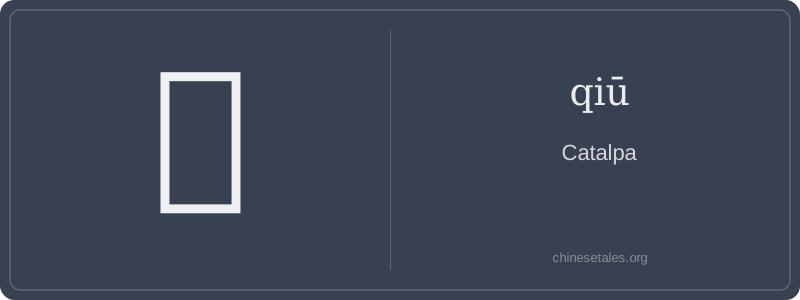
The earliest form of 楸 appears in seal script (around 300 BCE), where it clearly combines 木 (a stylized tree with roots and branches) on the left and 秋 (originally a pictograph of grain ripening under fire — later simplified to 禾 + 火) on the right. Over centuries, the fire (火) in 秋 shrank and shifted into the dot-and-hook shape we see today, while the 木 radical stabilized into its modern upright form. Crucially, the ‘autumn’ element wasn’t chosen for seasonality alone — ancient botanists observed that catalpa trees drop their large leaves dramatically in late autumn, and their seed pods mature precisely then, linking the tree’s life cycle to 秋’s core idea of ripening and release.
This visual pairing — wood + autumn — became inseparable. By the Han dynasty, 楸 appeared in the *Shuōwén Jiězì* dictionary as ‘a fine-grained hardwood tree whose timber resounds beautifully when struck’. Tang poets like Bai Juyi referenced 楸 in garden verses, describing its shade as ‘cool enough to hold a hundred years of thought’. Its form didn’t change much after the Song dynasty — a testament to how perfectly the composition captured both botanical identity and cultural resonance: a tree that grows tall, bears fruit in autumn, and yields wood worthy of music.
楸 (qiū) is a quiet, elegant character — not flashy like fire or water radicals, but deeply rooted in China’s botanical and literary soil. It names the catalpa tree: tall, graceful, with heart-shaped leaves and clusters of lavender-white flowers. In classical Chinese, 楸 wasn’t just a tree; it was a symbol of dignity and longevity — often planted beside ancestral halls or scholars’ gardens. You’ll rarely see it in daily conversation (hence its absence from HSK), but it appears with quiet authority in poetry, historical texts, and regional place names.
Grammatically, 楸 functions as a noun — almost always as part of a compound (e.g., 楸树, 楸木). It doesn’t take aspect particles like 了 or 过, nor does it appear as a verb or adjective. Learners sometimes mistakenly treat it like a generic ‘tree’ word and try to say *‘I plant a qiū’* — but native speakers would say 植一棵楸树, never *植一棵楸. Also, note: 楸 is not used alone as a pronoun or classifier — unlike 松 or 柏, which occasionally appear solo in poetic lines, 楸 almost always carries its radical-anchored identity: 木 (wood) + 秋 (autumn), making it unmistakably *botanical*, not seasonal.
Culturally, 楸 wood is prized for fine carving and traditional guqin soundboards — its resonance is said to carry ‘autumn clarity’. A common learner pitfall? Confusing it with 秋 (qiū, ‘autumn’) due to identical pronunciation and shared right-hand component. But while 秋 evokes harvest and melancholy, 楸 evokes stillness, craftsmanship, and silent height — like a scholar standing beneath a catalpa, not counting days, but listening to the wind in its broad leaves.