楹
Character Story & Explanation
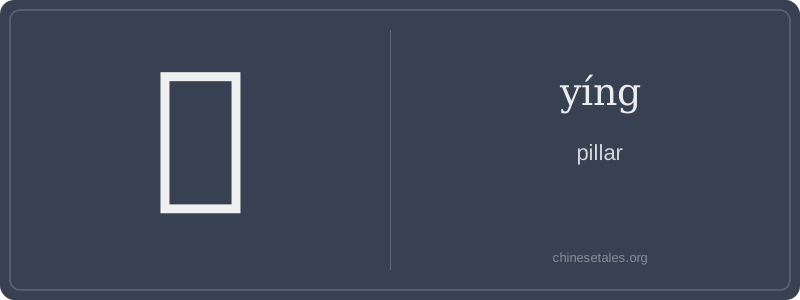
The earliest form of 楹 appears in bronze inscriptions (jinwén) as two parallel vertical strokes (representing upright posts) flanking a simplified ‘tree’ or ‘wood’ symbol — a clear pictograph of wooden pillars supporting a structure. Over time, the oracle-bone and seal-script forms stabilized the left side as the 木 (wood) radical, while the right side evolved from a phonetic component 颖 (yǐng, meaning 'ear of grain' — hinting at tapering shape and later lending sound) into today’s simplified 颖-like shape. Crucially, the original depiction wasn’t abstract: it showed paired, freestanding columns — not load-bearing walls — emphasizing symmetry and ritual space.
This visual logic shaped its semantic journey: from literal timber supports in Zhou-dynasty palaces, 楹 quickly became associated with the ceremonial axis of traditional buildings — the central corridor between two pillars defined sacred or authoritative space (e.g., ‘between the pillars’ — 两楹之间 — was where rulers received guests or where Confucius was said to have taught). In the Book of Rites, 楹 appears in descriptions of ancestral worship spaces, cementing its link to reverence and order. Its enduring presence in couplet culture isn’t decorative — it’s architectural grammar: the pillar doesn’t just hold up the roof; it holds up meaning.
At its heart, 楹 (yíng) is a highly specific kind of pillar: not just any vertical support, but the tall, elegant, often inscribed wooden columns that flank doorways and halls in traditional Chinese architecture — especially temples, ancestral halls, and classical gardens. Think of it as the architectural equivalent of a 'ceremonial spine': dignified, structural, and steeped in literary weight. Unlike generic words for pillar like 柱 (zhù), 楹 carries an unmistakable classical elegance — you’ll almost never hear it in modern construction talk or casual speech.
Grammatically, 楹 is a noun that rarely stands alone; it’s nearly always part of compound terms (like 楹联) or appears in poetic or descriptive contexts. It’s countable (e.g., 两楹 — 'two pillars'), but never used with measure words like 个. Learners sometimes mistakenly use it where 柱 would be natural — say, describing a concrete column in a subway station — which instantly sounds archaic or jarringly literary. Also, note: it’s almost exclusively *wooden* (thanks to the 木 radical), so calling a steel beam an 楹 would feel historically inaccurate and semantically off-key.
Culturally, 楹 is inseparable from the art of couplets — those parallel poetic lines written on red paper and pasted vertically on door pillars. This tradition, known as 楹联 (yínglián), turns architecture into literature: each pillar literally holds meaning. A common learner trap is misreading 楹 as yīng (like 英) due to visual similarity — but the correct tone is second, not first. And while it’s absent from HSK, encountering it in temple visits, classical poetry, or calligraphy exhibitions makes it a quiet cultural passport.