榭
Character Story & Explanation
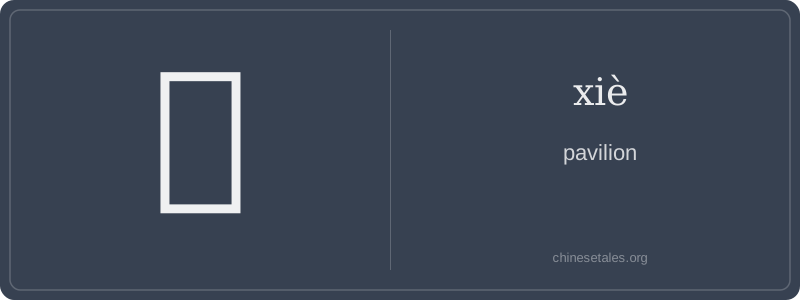
The earliest form of 榭 appears in seal script, where the left side clearly shows 木 (wood/tree), while the right side resembles 射 (shè, 'to shoot') — not as meaning, but as a sound-based component. Oracle bone inscriptions don’t contain 榭, but by the Warring States period, its structure stabilized: 木 + 射 — 14 strokes total, with the horizontal stroke of 射 elongating like a roof beam, and the three dots beneath suggesting pillars or reflections in water below. Over centuries, the 'arrow' part of 射 softened into the modern 射 shape, and the whole character gained an elegant, balanced asymmetry — echoing the very architecture it names.
By the Tang and Song dynasties, 榭 became synonymous with literati aesthetics: a place where poets composed verses gazing at lotus ponds or misty mountains. In the 17th-century garden manual *Yuanye* (The Craft of Gardens), 榭 is defined as 'a structure built on water or near water, open on all sides, for enjoying wind and moon.' Its visual form — wood above, 'shooting' outward — captures this duality: rooted in timber, yet reaching into landscape and sky. Even today, calling a building a 榭 implies intentionality, artistry, and philosophical resonance — not mere utility.
Think of 榭 (xiè) not as a generic 'pavilion' like a garden gazebo, but as China’s answer to the Greek temple — an elevated, open-sided architectural poem built for contemplation, not shelter. Unlike the functional 亭 (tíng) or ornate 楼 (lóu), a 榭 is deliberately perched over water or nestled in nature, designed to frame scenery like a living scroll painting. It’s not just a place — it’s a verb: to pause, observe, and harmonize with the environment.
Grammatically, 榭 is almost always a noun and appears in formal, literary, or descriptive contexts — never in daily speech ('Let’s meet at the pavilion!' would use 亭). You’ll find it in compound nouns (e.g., 水榭), poetry, classical garden names (like the famous Canglang Pavilion’s 沧浪亭), or travel writing. It rarely takes modifiers like 'big' or 'small'; instead, it’s paired with location words: 湖榭 (lakeside pavilion), 山榭 (mountain pavilion). Trying to say 'I built a pavilion' with 榭 sounds oddly grandiose — like saying 'I erected a basilica' when you meant 'I put up a shed.'
Culturally, confusing 榭 with simpler structures is a classic learner trap: its wooden radical (木) hints at construction, but its right side (射) isn’t about archery — it’s a phonetic clue (xiè), and historically evokes the idea of 'projecting outward', reflecting how the pavilion extends into space and view. Learners often misread it as 'xì' or skip the tone — but xiè is sharp, rising, like the upward sweep of its roof eaves.