榰
Character Story & Explanation
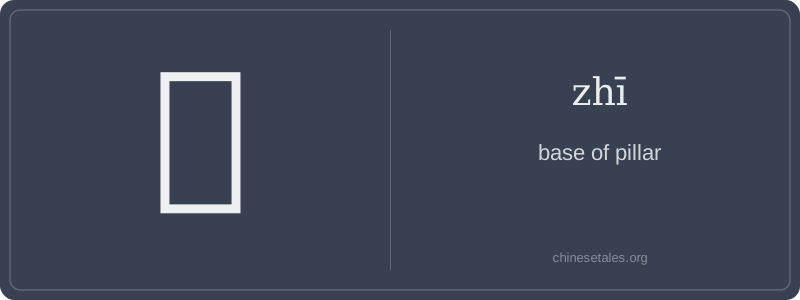
The earliest form of 榰 appears in Han dynasty seal script, not oracle bone — because it wasn’t needed earlier. Its composition is brilliantly literal: the left radical 木 (mù, 'tree/wood') frames the right side, which evolved from a simplified depiction of a squared stone block resting on a horizontal line — representing the ground. In bronze inscriptions, you can still see the faint outline of a stepped plinth beneath two parallel lines: the pillar above, the earth below. Over centuries, the ‘block’ condensed into the three horizontal strokes and the downward hook of the right component, while 木 retained its full six-stroke form — no simplification here, because the character was too rare to warrant it.
By the Tang dynasty, 榰 was standard in architectural treatises describing bracket sets (dougong) and column foundations in palaces and pagodas. The Yingzao Fashi (1103 CE) devotes a section to ‘proper proportions of column and 榰’, specifying exact ratios between pillar height and 榰 width. Its meaning never drifted — unlike many characters, it stayed stubbornly architectural. Interestingly, its sound zhī may echo the low, resonant hum of a heavy stone settling — a phonetic coincidence preserved across millennia, making it one of Chinese’s rare ‘onomatopoeic ideographs’.
Imagine walking into an ancient Chinese temple — not to admire the carvings, but to crouch and inspect the very ground beneath the pillars. That’s where 榰 (zhī) lives: not in grand pronouncements, but in the quiet, load-bearing silence of the pillar’s base — the stone or wooden platform that anchors towering columns to earth. It’s a deeply architectural, almost tactile word, evoking weight, stability, and hidden support. You won’t hear it in daily chat; it’s a term for carpenters, historians, and classical architecture buffs — think 'foundation block' or 'pillar plinth', not 'foot' or 'base' in the abstract sense.
Grammatically, 榰 is a noun and almost never stands alone in modern usage. It appears almost exclusively in compound nouns (like 柱榰 or 榰石) or in classical-style descriptive writing — never as a verb or adjective. Learners sometimes mistakenly treat it like 基 (jī, 'foundation') or 底 (dǐ, 'bottom'), but those are generic; 榰 is hyper-specific: only the *immediate supporting structure directly under a pillar*, often carved or fitted with precision. Using it incorrectly sounds like calling a doorknob 'a hinge' — technically adjacent, but conceptually off-target.
Culturally, 榰 embodies a quiet Confucian ideal: invisible strength. The pillar rises in glory, but 榰 bears the burden unseen — much like filial duty or scholarly perseverance. Modern learners rarely encounter it outside restoration texts or Song-Yuan dynasty building manuals (e.g., the Yingzao Fashi). A common mistake? Assuming it’s related to 枝 (zhī, 'branch') because of the shared pronunciation — but they share zero semantic or etymological roots. One is wood + branch; the other is wood + base — homophone coincidence, not kinship.