槽
Character Story & Explanation
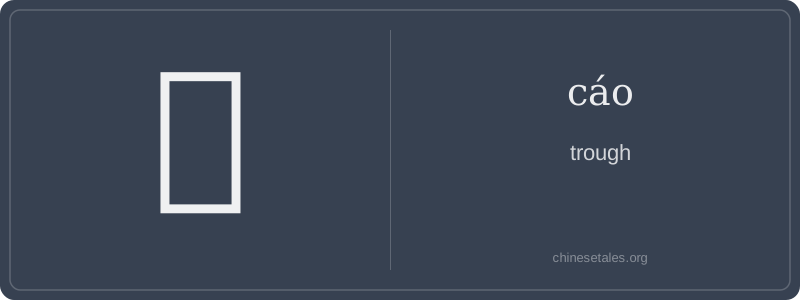
The earliest form of 槽 appears in bronze inscriptions as a stylized tree (木) beside two parallel horizontal lines representing a carved-out channel—like a log split lengthwise and hollowed. Over time, the ‘channel’ evolved into the right-hand component 曹 (cáo), originally a pictograph of two hands (臼) pressing grain in a mortar—hinting at containment and processing. By the Han dynasty, the full character merged 木 (wood, material) + 曹 (structured containment), crystallizing into today’s 15-stroke form: the left 木 radical anchoring it in the realm of crafted wooden objects, the right 曹 adding phonetic value and semantic weight of organized capacity.
This evolution mirrors its semantic journey: from literal wooden feeding troughs in Zhou dynasty texts (e.g.,《诗经》‘我马维驹,六辔如濡,载驰载驱,周爰咨诹’—horses needing proper troughs) to metaphors of capacity and receptivity. In classical medicine, 牙槽 (yá cáo) emerged for the bony ‘trough’ holding teeth; by the 20th century, engineers adopted it for standardized grooves in machinery—and now, your phone’s SIM slot. The character didn’t shrink or soften; it scaled up, carrying its ancient logic of precise, functional containment across millennia.
Imagine a sturdy wooden channel carved to hold something essential—grain for horses, water for irrigation, or molten metal in ancient foundries. That’s the soul of 槽 (cáo): not just any hollow, but a purpose-built, functional trough—deep, grounded, and built to contain. Its core feeling is utilitarian resilience: it’s never decorative; it’s always *for use*. You’ll rarely see it alone—it thrives in compounds like 马槽 (mǎ cáo, horse trough) or 水槽 (shuǐ cáo, sink), where its meaning anchors the object’s function.
Grammatically, 槽 is almost always a noun, typically appearing after a classifier (e.g., 一个槽) or as the head noun in compound nouns. Crucially, it’s *not* used for generic ‘holes’ or ‘dents’—that’s 坑 (kēng) or 凹 (āo). Learners sometimes force 槽 into contexts like ‘phone slot’ (thinking of the SIM tray), but native speakers say 卡槽 (kǎ cáo)—yes, that *is* the exception! Here, 槽 specifically denotes a precisely engineered groove, reinforcing its identity as a designed channel, not an accidental cavity.
Culturally, 槽 carries quiet industrial dignity: from Confucian-era granaries to modern data centers (where ‘rack slots’ are still called 机架槽), it embodies functional precision. A common mistake? Overgeneralizing it to mean ‘groove’ in all contexts—e.g., saying *牙齿槽* instead of 牙槽 (yá cáo, dental alveolus), which *is* correct, but only because dentistry borrowed the metaphor of bony ‘troughs’ holding teeth. It’s a character that rewards attention to engineering logic—not just shape.