槿
Character Story & Explanation
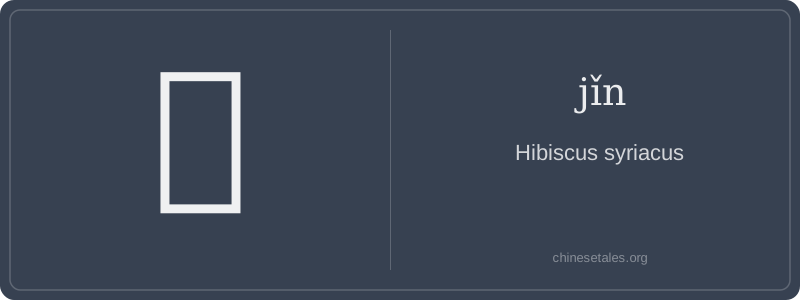
The earliest form of 槿 isn’t found in oracle bones — it’s a later creation, appearing in seal script around the Warring States period. Visually, it’s a clear phono-semantic compound: left side 木 (mù, ‘tree’) declares its botanical category; right side 晋 (jìn) provides the sound clue — though modern pronunciation shifted from *jìn* to *jǐn*, likely due to tonal evolution in Middle Chinese. The seal script version already shows the tall, upright trunk of a shrub with layered branches — and the 晋 component, originally depicting two hands lifting a sun (日) over an arrow-like base, gradually stylized into today’s 10-stroke cluster. Stroke order reflects this logic: first the 木 radical (4 strokes), then the intricate 晋 (11 strokes) built carefully from top to bottom.
By the Tang dynasty, 槿 was firmly established in botanical texts like *Xinxiu Bencao*, described as ‘a bushy tree bearing five-petaled flowers, pink or white, opening at dawn’. Its literary resonance deepened: Li Shangyin wrote of ‘the hibiscus gate’ (槿篱) — not a real gate, but a fence woven from pruned stems, symbolizing rustic simplicity and impermanence. Crucially, the character’s visual balance mirrors the plant itself: sturdy 木 root anchoring the elegant, slightly asymmetrical 晋 — like a slender stem supporting fragile, radiant blooms.
Imagine walking through a quiet Korean village in late summer — the air thick with the sweet, honeyed scent of purple blossoms clinging stubbornly to slender branches despite the cooling breeze. That flower is the *mugunghwa*, Korea’s national symbol — and in Chinese, it’s called 木槿 (mù jǐn), named after the plant 槿. This isn’t just any hibiscus: it’s the hardy, day-blooming *Hibiscus syriacus*, whose delicate flowers open at dawn and wilt by dusk — a poetic metaphor for fleeting beauty and resilience. In Chinese, 槿 appears almost exclusively in botanical or literary contexts; you’ll rarely hear it in daily speech, and never alone — it always rides into conversation on compound words like 木槿 or 槿花.
Grammatically, 槿 is a noun-only character — no verbs, no adjectives, no slangy shortenings. It never takes aspect markers (了, 过) or plurals (*槿们* doesn’t exist). Learners sometimes try to use it like 花 (huā, ‘flower’) — saying *我种槿* — but that’s unnatural; native speakers say *我种木槿* or *我养槿花*. Even in writing, omitting 木 or 花 feels incomplete, like naming a friend ‘Smith’ without a first name. Its tone (jǐn, third) is easy to mispronounce as jīn (first) — a slip that won’t cause confusion (no common homophone), but signals unfamiliarity with its poetic register.
Culturally, 槿 carries gentle melancholy and quiet dignity. Unlike flamboyant peonies or auspicious plum blossoms, it’s admired for endurance — blooming for months, surviving droughts and poor soil. Classical poets like Bai Juyi praised its ‘morning bloom, evening fall’ rhythm as a mirror of human life. Modern learners often overlook it entirely because it’s HSK-free — yet encountering it in poetry, garden signage, or Korean-Chinese cultural texts reveals how deeply botany and symbolism are woven into Chinese literacy.