橕
Character Story & Explanation
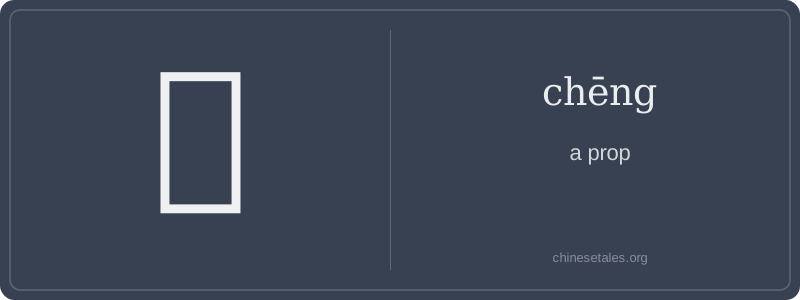
The earliest form of 橕 appears not in oracle bones, but in Han dynasty bronze inscriptions and early clerical script — and it’s a masterclass in semantic transparency. Its left side, 木 (mù, 'tree/wood'), anchors it firmly in the material world of timber structures. Its right side, 章 (zhāng), originally depicted a 'tally' or 'seal' — but here, crucially, it functions phonetically *and* semantically: the components 尚 (shàng, 'still, yet') + 十 (shí, 'ten', symbolizing completeness) suggest 'what remains upright, fully supported'. Over centuries, the seal-like complexity of 章 simplified into today’s elegant, angular right-hand component — yet the sense of deliberate, authoritative reinforcement never faded.
By the Tang dynasty, 橕 was already specialized: unlike the broader 撑 (chēng), which could mean 'to push open' or 'to hold up loosely', 橕 appeared in architectural texts like the *Yingzao Fashi* (1103 CE) to denote load-bearing wooden struts — critical elements in temple beams and bridge abutments. Classical poets avoided it (too technical!), but Ming dynasty carpenters’ manuals used it reverently, linking it to Confucian ideals of steadfastness: just as a pillar 橕s a roof, a virtuous person 橕s moral order. The character’s visual heft — tall, vertical, unbroken — mirrors its meaning: unwavering structural integrity.
At its heart, 橕 (chēng) isn’t just 'a prop' — it’s the quiet, muscular verb for *actively holding something up against gravity or collapse*. Think scaffolding in a typhoon, or a shoulder bracing a crumbling wall. It carries weight, urgency, and intention: you don’t 橕 passively; you commit your body, leverage, and will. That’s why it rarely appears alone — it’s almost always part of a compound like 橕住 (chēng zhù, 'to brace firmly') or 橕杆 (chēng gān, 'supporting pole'). You won’t hear it in casual speech ('I’ll prop the door open'), but you *will* see it in engineering reports, safety manuals, or dramatic literature where stakes are physical and high.
Grammatically, 橕 is almost exclusively a transitive verb — it needs a direct object. Learners often mistakenly use it like English 'prop' as a noun ('a prop'), but 橕 is never a thing — it’s the *action* of propping. Also, tone matters: chēng (first tone) is distinct from chèng (fourth tone, 'to weigh') and chēng (second tone, archaic 'to praise'). Mispronouncing it risks sounding like you’re praising a beam instead of holding it up!
Culturally, this character reveals how Chinese conceptualizes support: not as passive assistance, but as embodied, structural intervention. It’s the same mindset behind 'holding up the sky' (顶天立地) — dignity through bearing weight. A common mistake? Using it for light, temporary props (e.g., a book holding open a door). For that, Chinese prefers 撑 (chēng), which *does* cover casual, flexible support — making 橕 feel more heroic, technical, and unyielding.