橛
Character Story & Explanation
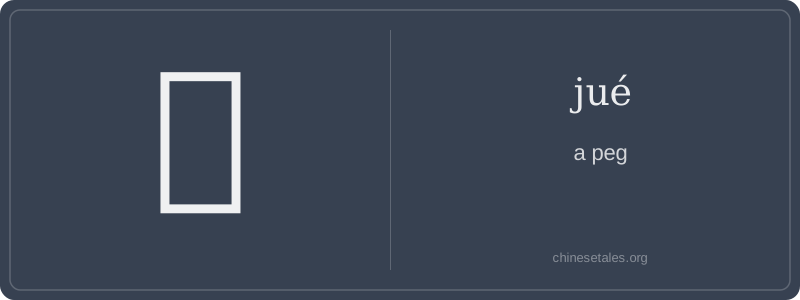
The earliest form of 橛 appears in Warring States bamboo slips, not oracle bones — and it’s brilliantly literal: a vertical 木 (tree/wood) radical on the left, paired with 厥 (jué) on the right, which itself evolved from a pictograph of a person kneeling beside a weapon-like object (originally 虍 + 大 + 又), suggesting 'driving down forcefully'. Over centuries, the right side simplified from complex bronze script forms into today’s 厥 — still retaining that sense of forceful insertion. The 16 strokes aren’t arbitrary: 4 for 木, then 12 carefully layered strokes in 厥 that mimic the rhythmic motion of hammering a stake — down, across, down again.
In classical usage, 橛 carried quiet authority: in the *Book of Rites* (Lǐjì), it marked ritual boundaries — a wooden peg drove into sacred ground to demarcate space where heaven and earth met. By the Tang dynasty, poets like Du Fu used 橛 metaphorically: '马头高橛' (mǎ tóu gāo jué) — 'the horse’s head raised high like a tall peg' — implying stubborn, unyielding posture. Visually, the character’s tall, narrow shape (16 strokes, 木 + 厥) mirrors the upright, slender profile of a real wooden peg — no curve, no flourish, just purposeful verticality.
Think of 橛 (jué) as the Chinese cousin of a tent peg — not flashy, but utterly indispensable when things get unstable. It’s a humble wooden stake driven into the ground to anchor something: a tent, a fence post, or even a horse tethered in classical texts. Unlike English 'peg', which can be metal or plastic, 橛 is intrinsically wooden (hence the 木 radical) and carries an earthy, functional weight — it’s never decorative, always utilitarian, and often implies temporary yet vital anchoring.
Grammatically, 橛 is almost exclusively a noun, rarely used alone in modern speech; instead, it appears in fixed compounds like 桩橛 (zhuāng jué, 'stake-and-peg') or in literary or technical contexts describing physical anchoring points. You won’t hear it in casual chat ('I need a peg'), but you *will* see it in agricultural manuals, historical novels, or descriptions of traditional construction — e.g., '把绳子系在橛上' (bǎ shéngzi jì zài jué shàng). Crucially, it’s not interchangeable with 钉 (dīng, 'nail') — nails pierce; 橛s are hammered *into soil*, not wood or wall.
Culturally, 橛 subtly evokes stability amid flux — a tiny wooden anchor in a shifting world. Learners often misread it as 'jue' like 决 (jué, 'to decide') due to identical pinyin and tone, but there’s zero semantic overlap. Worse, some confuse its right-hand component (厥) with 居 (jū) or 宜 (yí), leading to miswriting. Remember: if it has 木 on the left and feels like something you’d hammer into dirt — it’s 橛.