檑
Character Story & Explanation
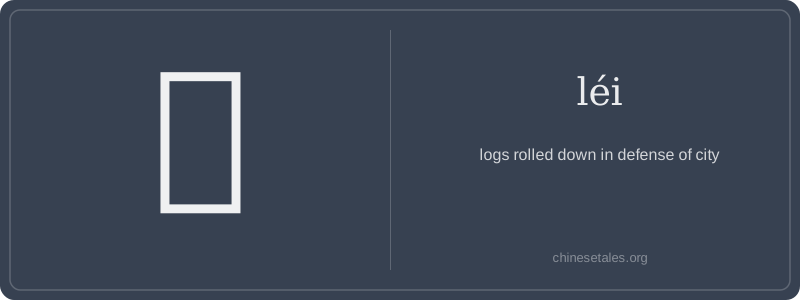
The earliest form of 檑 appears in Han dynasty bamboo slips—not oracle bone, but mature clerical script—with a clear two-part structure: left side 木 (tree/wood), right side 雷 (léi, thunder). But 雷 here isn’t for sound—it’s purely phonetic, borrowed for its pronunciation. The original bronze inscriptions show a simplified log shape beside a zigzag symbol (lightning-like, later standardized as 雷), evoking rapid downward motion—like thunderbolts *and* falling timbers both strike with sudden force. Over centuries, the 木 radical stayed firm on the left, while the right evolved from a dynamic lightning glyph into the formal 雷 with its 田 + 雨 components, locking in 17 strokes by the Song dynasty standard.
This visual duality shaped its semantic journey: early texts like the *Mozi* (c. 4th c. BCE) use 檑 specifically for 'defensive logs rolled from city walls', contrasting it with static terms like 柱 (pillar) or 梁 (beam). By the Tang, poets like Du Fu referenced 檑 metaphorically—'the fallen 檑 of Chang’an' evoking shattered defenses and lost order. Crucially, the '雷' component never meant 'thunder' here; it was chosen *only* for its léi sound, reinforcing how Chinese characters often prioritize phonetics over pictorial logic—a reminder that etymology is part linguistics, part historical accident.
Imagine a besieged Warring States city at dawn: defenders heave massive pine logs over the battlements—*thud, crash, splinter!*—sending them tumbling down the ramparts to crush enemy ladders and troops. That visceral, thunderous moment is 檑 (léi): not just 'logs', but *defensive rolling timber*, a weaponized noun with built-in motion and purpose. In classical Chinese, it’s almost always a countable noun—'one 檑', 'three 檑'—and appears almost exclusively in military texts or historical narratives. You’ll never see it in modern spoken Mandarin; it’s fossilized in classical prose and poetry.
Grammatically, 檑 functions like a concrete object noun, but with heavy contextual weight—it implies siege warfare, urgency, and ingenuity. Learners sometimes misread it as *lěi* (like 累) due to the ‘雷’ component, or mistakenly pair it with modern wood-related words like 桌子 or 树. But 檑 isn’t about furniture or forests—it’s about physics, gravity, and desperation. It appears in set phrases like 檑木 (léi mù)—literally 'rolling-wood'—which *only* means 'logs used defensively', never 'wood that rolls casually'.
Culturally, 檑 embodies a fascinating quirk of ancient Chinese warfare: turning raw timber into tactical artillery. Its rarity today makes it a 'time capsule character'—encountering it signals you’re reading Sima Qian or the *Mozi*, not WeChat. A common mistake? Assuming it’s related to 雷 (thunder) because of the phonetic '雷'; while the sound matches, the meaning has zero connection to weather—it’s purely about motion + wood. This character doesn’t whisper; it *rumbles*.