椟
Character Story & Explanation
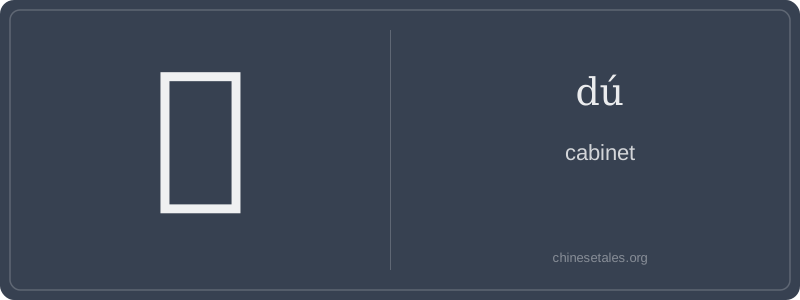
The earliest form of 椟 appears in Warring States bamboo slips as a pictograph combining 木 (tree/wood) on the left and 贖 (shú, originally depicting a shell + 'to redeem') on the right — though crucially, the right side evolved from an older glyph meaning 'to enclose securely'. The original bronze script showed a stylized wooden chest with a hinged lid and internal compartments, its strokes mimicking grain patterns and dovetail joints. Over centuries, the right component simplified from 貝 (shell, symbolizing value) + 兌 (duì, 'to exchange') to 賣 (mài, 'to sell') and finally to 赎 (shú), but in 椟, it fossilized as a phonetic-semantic hybrid: the wood radical declares material, while the right side hints at pronunciation (dú sounds close to dú in 賣, now mài) and the idea of 'holding something valuable for safekeeping'.
This character blossomed in classical texts — most famously in the Analects (17.1), where Confucius laments people who ‘prize the 椟 over the pearl’, using it as a metaphor for superficial judgment. By the Tang and Song dynasties, 椟 denoted scholar’s boxes for brushes, ink, and seals — objects that weren’t merely functional but embodied self-cultivation. Its visual structure — wood + 'secure enclosure' — never strayed from its core idea: dignified containment. Even today, museum labels for Ming-dynasty lacquer cabinets still use 椟 to evoke that lineage of reverence.
At first glance, 椟 (dú) feels like a quiet, dusty word — not the kind you’d hear in daily chat or see on subway ads. It means 'cabinet' or 'case', but not your IKEA Billy bookshelf; think of an ornate, lacquered wooden box for storing precious scrolls, jade, or ancestral tablets. In classical Chinese, 椟 carried gravitas: it wasn’t just storage — it was dignified containment, reflecting Confucian values of reverence, order, and respect for what’s hidden yet sacred. That’s why it appears in idioms like 买椟还珠 (mǎi dú huán zhū) — 'buying the case and returning the pearl' — a biting critique of valuing packaging over substance.
Grammatically, 椟 is almost always a noun, rarely used alone in modern speech. You’ll encounter it mostly in set phrases, literary allusions, or formal writing about antiques, museums, or traditional craftsmanship. Learners sometimes mistakenly use it like 箱 (xiāng) or 柜 (guì), but 椟 implies artistry, antiquity, and intentional elegance — never a cardboard moving box. It’s also tone-sensitive: dú (second tone) is easily mispronounced as dù (fourth tone, meaning 'to cross'), which would confuse listeners entirely.
Culturally, 椟 reveals how Chinese language treats objects as vessels of meaning: the wood radical (木) isn’t just material — it signals authenticity, warmth, and human craft. Modern usage is rare, but when 椟 appears, it’s often with quiet irony or scholarly weight. Mistake it for a generic 'box', and you’ll miss the whisper of Song-dynasty calligraphers carefully placing their inkstones into carved rosewood cases.