栎
Character Story & Explanation
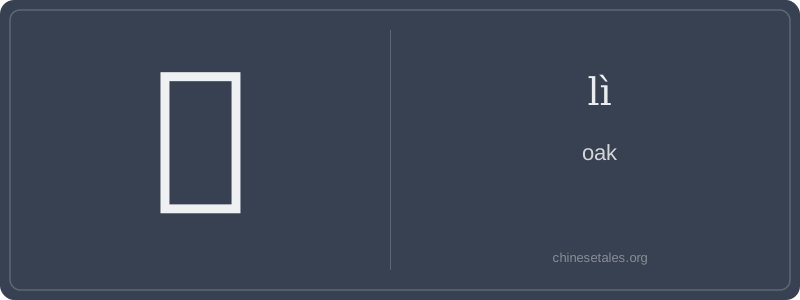
The earliest forms of 栎 appear in seal script (c. 3rd century BCE), where it already shows its dual nature: a clear 木 on the left, and on the right, a stylized 厉 — originally depicting a person holding a weapon (厂 + 万), later simplified to indicate severity and sound. Unlike pictographs of trees that show branches (like 森), 栎’s right side never illustrated leaves or acorns; instead, scribes chose 厉 for its phonetic match and its connotation of toughness — an elegant linguistic shorthand: ‘the strict tree,’ i.e., the hardy, long-lived oak that withstands storms and time.
This semantic-phonetic pairing stabilized by the Han dynasty. Classical texts rarely name 栎 directly, but it appears in encyclopedic works like the Bencao Gangmu, where Li Shizhen notes ‘栎实’ (lì shí, ‘oak acorns’) as famine food and medicinal astringent. Its visual form — nine strokes, balanced yet angular — mirrors the oak’s aesthetic: upright, unadorned, structurally emphatic. Even today, when you write the final stroke of 厉 (a sharp, downward捺), you’re echoing the decisive fall of an acorn — small, dense, and full of latent strength.
At its heart, 栎 (lì) is a quiet botanical specialist — it doesn’t mean ‘tree’ in general, nor even ‘hardwood,’ but specifically ‘oak’: the sturdy, acorn-bearing, slow-growing symbol of endurance in both Chinese forests and classical imagination. Visually, it’s a perfect semantic-phonetic compound: the left 木 (mù, ‘tree’) radical anchors it firmly in the arboreal world, while the right side 厉 (lì, ‘strict, severe’) hints at pronunciation *and* subtly evokes the oak’s tough, unyielding nature — as if the tree itself embodies disciplined strength.
Grammatically, 栎 behaves like most noun-classifier nouns: it appears in botanical or ecological contexts, rarely in casual speech. You won’t hear ‘I love oak’ in daily chat — instead, it surfaces in terms like 栎树 (lì shù, ‘oak tree’) or in scientific names (e.g., 槲栎, hú lì, ‘sawtooth oak’). Learners often misread it as lǐ (like 李) or confuse it with 利 (lì, ‘benefit’), leading to baffling sentences like ‘this benefit tree grows in mountains.’ Remember: 木 + 厉 = oak, not advantage!
Culturally, oaks were never mythic giants like pine or plum in Chinese poetry — they’re pragmatic, resilient, and quietly revered in regional forestry. In southern China, certain 栎 species supply tannin for traditional leatherwork, and their durable wood was historically used for mill wheels and tool handles. The character carries no poetic clichés — its power lies in precision. That’s why it’s absent from HSK: it’s not about frequency, but fidelity — a botanist’s word, not a conversational one.