櫠
Character Story & Explanation
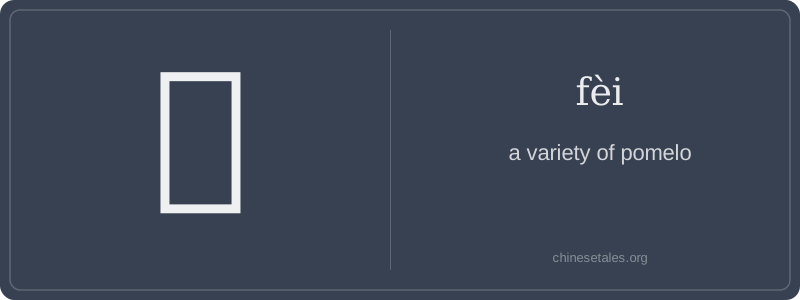
The earliest trace of 櫠 appears not in oracle bones — too late for that — but in Song-dynasty woodblock-printed agricultural manuals. Visually, it’s a masterclass in semantic-phonetic construction: left side 木 (mù, 'tree') declares its domain; right side 費 (fèi, 'to expend, costly') provides both sound and subtle meaning — suggesting a tree demanding care and resources to bear its prized fruit. Stroke-by-stroke, it evolved from simplified hand-copied variants: the 木’s horizontal stroke sharpened, the 費’s 貝 (shell, currency) component condensed, and the overall structure tightened into today’s 19-stroke form — elegant, dense, and quietly demanding attention.
By the Ming dynasty, 櫠 appeared in Li Shizhen’s *Bencao Gangmu* (1596), classified under 'fruits that harmonize qi and soothe the lungs', linking it to traditional medicine. Its meaning never broadened — unlike many characters that shifted from concrete to abstract, 櫠 stayed stubbornly botanical. No classical poetry invokes it metaphorically; no idioms feature it. Its visual weight — all those strokes crammed into one character — mirrors its real-world rarity: a fruit so particular, it earned its own glyph. Even today, farmers in Zhaoqing still call their finest pomelos '櫠', preserving the word like heirloom seed.
Meet 櫠 — a botanical ghost in the Chinese character system. Pronounced fèi, it names a specific, rare variety of pomelo (Citrus maxima), not the generic 'pomelo' you’d find on supermarket shelves. It’s not just 'a citrus'; it’s a regional cultivar with thick rind and mild, floral flesh — historically prized in southern China’s Guangdong and Fujian provinces. The character feels archaic and hyper-specific: you’ll almost never see it in daily conversation or modern media. It lives in agricultural texts, local gazetteers, and old herbal compendia — like a quiet footnote in China’s food history.
Grammatically, 櫠 functions exclusively as a noun, always modified by classifiers (e.g., 一个櫠, 这棵櫠) or paired in compound terms like 櫠子 (fèi zi, 'pomelo fruit'). It never appears alone in speech; native speakers say 柚子 (yòu zi) for 'pomelo' broadly — using 櫠 would sound like saying 'Granny Smith' when you mean 'apple'. Learners sometimes misread it as fēi (like 飞) due to the 'fèi' tone’s rarity — but that slip turns a citrus into… well, nothing, because no common word sounds like 'fēi' + this shape.
Culturally, 櫠 is a linguistic relic of pre-standardized horticulture — a time when local varieties had distinct names before Mandarin generalized them under broader terms. Mistake it for 悲 (bēi, 'sorrow')? You’ll evoke heartbreak instead of harvest. Its radical 木 (wood/tree) anchors it firmly in botany, while the right side 費 (fèi, 'costly, expend') hints at its historical value: this wasn’t just fruit — it was labor-intensive, land-specific, and worth naming separately. Think of it as the 'Heirloom Brandywine Tomato' of Chinese citrus.