棂
Character Story & Explanation
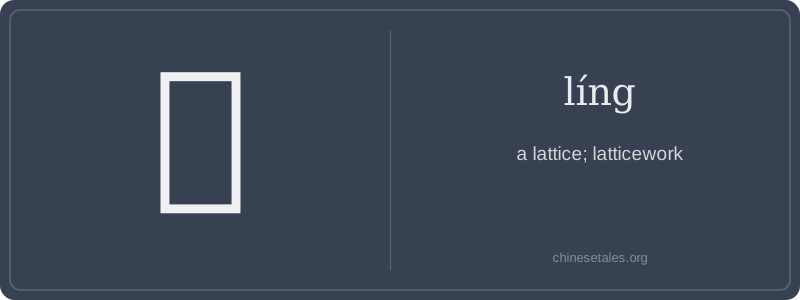
The earliest form of 棂 appears in late Warring States bamboo slips — not as a pictograph of wood, but as a stylized diagram: two parallel vertical strokes (representing upright wooden posts), crossed by three evenly spaced horizontal strokes (the transverse slats), all enclosed within a simplified 'wood' frame (木). Over centuries, the 'wood' radical stabilized on the left, while the right side evolved from a schematic grid into the elegant 令 component — not for 'command', but as a phonetic clue (both 棂 and 令 share the líng sound in Middle Chinese). The eleven strokes crystallized by the Tang dynasty: four for 木, seven for 令 — each stroke echoing the precision of carpentry.
This character didn’t emerge from abstract thought but from the workshop: it first appeared in Han dynasty technical texts describing palace gate construction, where 'window lattices must be uniform in spacing' (棂距宜均). By the Ming-Qing era, 棂 became inseparable from literati aesthetics — Shen Kuo’s *Dream Pool Essays* praises 'the breath of wind through lacquered 棂' as essential to a scholar’s calm. Visually, the 木 radical roots it in craftsmanship, while the 令 component’s crisp angles mirror the exactitude required in joinery: no curve, no flourish — only disciplined repetition, like a master carpenter tapping each slat into place with the same measured rhythm.
At its heart, 棂 (líng) is the quiet poetry of wood and air — not just 'lattice' as a dry architectural term, but the elegant, rhythmic breathing space between solid and void in traditional Chinese design. It evokes the delicate wooden grids in temple windows, courtyard gates, or scholar’s study screens: functional yet deeply aesthetic, structural yet symbolic of refinement and restraint. Native speakers don’t say 'there’s a 棂' like 'there’s a chair'; it appears almost exclusively in compound nouns (like 槅扇棂 or 冰裂纹棂) or descriptive phrases about classical buildings — you’ll rarely see it stand alone in speech.
Grammatically, 棂 is a noun-only character with no verb or adjective forms. It never takes aspect particles (了, 过), nor does it appear in casual conversation — think of it as a 'heritage word': reserved for restoration reports, art history lectures, or poetic descriptions of old gardens. Learners often mispronounce it as líng (correct) vs. lín or líng — but the bigger trap is overusing it: no one says 'my window has 棂' — they’d say 'my window has lattice panels' (窗棂) or simply describe the pattern. It’s always paired — the character itself feels incomplete without its partner.
Culturally, 棂 carries subtle Confucian resonance: its orderly, repeating lines reflect harmony through discipline — each slat precisely spaced, neither too tight nor too loose. Mistaking it for similar-sounding characters (like 灵 or 零) breaks the image entirely: you wouldn’t want to call a Song-dynasty lattice a 'spirit' (灵) or 'zero' (零). Its rarity in modern spoken Chinese makes it a beautiful marker of cultural literacy — spotting it in a museum caption or garden guidebook is like finding a hidden seal of authenticity.