欨
Character Story & Explanation
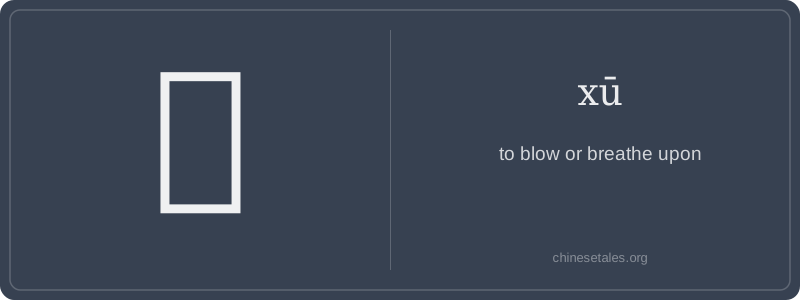
The earliest form of 欨 appears in bronze inscriptions as two components stacked: the ‘mouth’ radical (口) at the top, and below it a simplified depiction of ‘vapor rising’—not steam, but wispy, directional breath, rendered as three faint, upward-curving strokes. Over centuries, the lower part stylized into the current 虛 component (which itself means ‘empty’ or ‘hollow’), reinforcing the idea of breath emerging from emptiness—the void before sound, the pause before exhalation. The mouth stays firmly atop, anchoring the action as oral and intentional.
This visual logic shaped its meaning: not generic breathing (that’s 呼 or 吸), but breath *released with purpose upon an object*. In the Shuōwén Jiězì (121 CE), Xu Shen defines it as ‘to blow upon (yú) something gently’—and cites its use in describing how sages ‘xū fire’ to revive dying coals without extinguishing them. Later, in Tang dynasty poetry, it appears in lines about monks 欨香 (xū xiāng)—blowing over incense to kindle fragrance, symbolizing the subtle transmission of wisdom. Its shape literally breathes meaning: mouth + emptiness = breath given form.
Imagine a Daoist master in a misty mountain grotto, exhaling slowly—no puff of breath, no visible vapor, but a deliberate, almost sacred act of blowing *upon* a smoldering incense stick to coax it back to life. That’s 欨 (xū): not just ‘to breathe’ or ‘to blow’, but to emit air *with intention and direction*, like a gentle, focused breath *upon* something fragile or receptive. It’s poetic, archaic, and deeply tactile—less about respiration, more about ritualized breath-as-action.
Grammatically, 欨 is almost always transitive and literary: you 欨 + object (e.g., 欨火, 欨香). It rarely stands alone; you won’t say ‘I xū’—you’ll say ‘he xūed the embers’. It’s verb-only, never used as a noun or adjective, and almost never appears in modern spoken Chinese—it lives in classical poetry, medical texts (e.g., ‘blowing qi onto acupuncture points’), and Daoist liturgy. Learners often misread it as a variant of 嘘 (xū, ‘shush!’) or confuse it with 吁 (xū/yù, ‘to sigh/call out’), but those are about sound or emotion—not directed airflow.
Culturally, 欨 carries quiet reverence. In ancient texts like the Zhuangzi, it evokes the ‘breath of heaven’—subtle, life-sustaining, and invisible. Mistaking it for common verbs like 吹 (chuī, ‘to blow’—forceful, loud, physical) misses its nuance: 欨 is softer, slower, and imbued with care. A learner who writes ‘他欨风’ (he xū wind) instead of ‘他吹风’ sounds like they’re performing Taoist breathwork on a breeze—poetic, but utterly ungrammatical.