歃
Character Story & Explanation
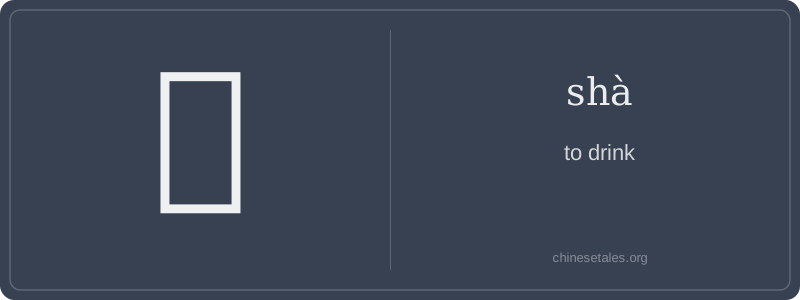
The earliest form of 歃 appears on Warring States bamboo slips as a compound pictograph: a stylized ‘mouth’ (口) above ‘water’ (氵) — but crucially, the water was written with three wavy strokes representing *flowing liquid*, and beneath it sat the radical 欠 (qiàn), meaning ‘to yawn’ or ‘to open mouth wide’ — hinting at intentional, deliberate intake. Over centuries, the water simplified into the three-dot 氵 on the left, while the right side evolved from a phonetic component ‘枼’ (yè, now obsolete) into today’s ‘臿’-like shape — a visual fossil of ancient syllabic borrowing, preserving the shà sound despite losing its original meaning.
This character’s meaning never strayed far from its ritual roots. In the Zuo Zhuan, we read of feudal lords 歃血 (shà xuè) — sipping mingled blood — to affirm treaties. Even in Tang poetry, 歃 appears only in contexts of solemn vows or military pacts. Its visual structure reinforces its function: the left-side 氵 signals liquid, the right-side ‘臿’ (originally ‘to insert’) suggests *intentional placement* of the mouth over the vessel — not casual drinking, but a controlled, symbolic act. The character itself is a miniature ritual choreography frozen in ink.
At its heart, 歃 (shà) isn’t just ‘to drink’ — it’s *ritual drinking*: the solemn, symbolic act of sipping blood or wine to seal a covenant, swear loyalty, or bind oaths. Think less ‘grabbing a soda’ and more ‘kneeling before ancestral altars with a bronze cup in hand’. Its core feeling is weighty, archaic, and deeply performative — this character lives in classical texts, historical dramas, and formal rhetoric, not daily chatter.
Grammatically, 歃 is almost always transitive and appears in fixed literary collocations like 歃血为盟 (shà xuè wéi méng — ‘to sip blood and form an alliance’). It rarely stands alone; you won’t say ‘I 歃 tea’. Instead, it functions as a high-register verb requiring a ritual object (blood, wine, oath) and often appears in passive or descriptive clauses: ‘The generals 歃 blood under the moon’. Learners mistakenly treat it like common verbs like 喝 (hē), but using 歃 outside ceremonial or literary contexts sounds jarringly theatrical — like saying ‘I doth partake’ at a coffee shop.
Culturally, 歃 evokes ancient Zhou dynasty rites where nobles would cut fingers, mix blood with wine, and sip together — a visceral, irreversible pledge. Modern usage is almost exclusively metaphorical or historical: politicians ‘歃血为盟’ in speeches to evoke unity; novels use it for dramatic oath-swearing. A key mistake? Confusing it with 沫 (mò, ‘foam’) or 沙 (shā, ‘sand’) — both share the ‘sh-’ sound but zero semantic kinship. 歃 isn’t about liquid *state* — it’s about liquid *sacrament*.