殈
Character Story & Explanation
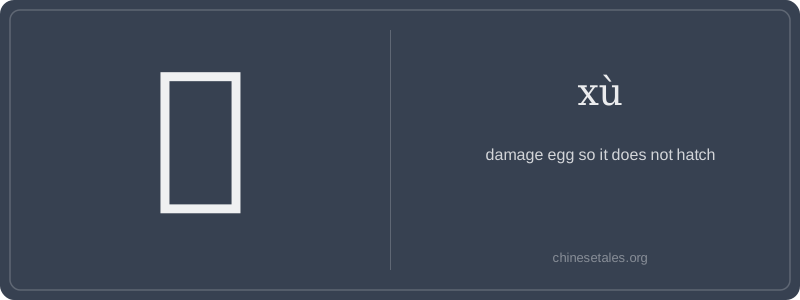
The earliest form of 殈 appears in Warring States bamboo slips (c. 475–221 BCE) as a compound glyph: the death radical 歹 on the left, paired with a simplified, asymmetrical variant of 半 — not the symmetrical modern 半, but one with a slanted top stroke and uneven legs, evoking a cracked or lopsided eggshell. Oracle bone inscriptions don’t contain it; it emerged later, when scribes needed a term for deliberate, fatal harm to embryonic life — perhaps for ritual records or veterinary manuals. Over centuries, the right side standardized into 半, while the left solidified as the grim, jagged 歹, reinforcing the semantic weight of irrevocable decay.
This character’s meaning stayed remarkably stable across two millennia: from the *Book of Rites* (Lǐjì) references to ‘preserving the unhatched’ (保殈) — implying ritual duty to prevent such loss — to Tang dynasty poetry lamenting ‘frost-emptied nests’ (霜殈巢), where 殈 conveys not mere breakage but the quiet, devastating moment potential dies before birth. Its visual logic is hauntingly literal: 歹 (death) + 半 (phonetic, yet uncannily suggestive of something severed mid-process) = life aborted at its most fragile threshold.
Let’s cut to the chase: 殈 (xù) isn’t just ‘damage’ — it’s *precisely* about ruining an egg so it fails to hatch. That specificity is rare in Chinese characters, and it’s baked into its very structure. The left side, 歹 (dǎi), is the ‘death/corruption’ radical — think of it as a visual warning label for irreversible loss or decay. The right side, 半 (bàn), literally means ‘half’, but here it’s not about division; it’s a phonetic clue (ancient pronunciation was closer to *suan* or *syaŋ*, evolving into xù) — and visually, it hints at incompleteness: a life cut short, an embryo left *half-formed*. This isn’t casual breakage — it’s biological sabotage.
Grammatically, 殈 is almost never used alone. It’s strictly literary, appearing only in classical compounds like 殈卵 (xù luǎn) or 殈育 (xù yù), and always carries a tone of tragic, unnatural interruption — like a farmer discovering frost-killed eggs in spring. You’ll *never* see it in modern spoken Mandarin or beginner texts; even advanced learners rarely encounter it outside classical poetry or agricultural treatises. Mistaking it for common words like 碎 (shuì, ‘broken’) or 坏 (huài, ‘spoiled’) is a dead end — those lack the biological finality and ritual gravity this character holds.
Culturally, 殈 taps into ancient Chinese cosmology where eggs symbolize potential, renewal, and cosmic order (think of the Pangu creation myth). To 殈 an egg wasn’t just waste — it was a microcosmic violation of life’s natural course. Modern learners often misread the 半 as ‘half’ and assume the meaning is vague or quantitative — but no: 半 here is purely phonetic scaffolding. The core is 歹 + irreversible failure. Its near-total absence from daily language makes it a linguistic fossil — beautiful, precise, and utterly obsolete outside scholarly contexts.