殥
Character Story & Explanation
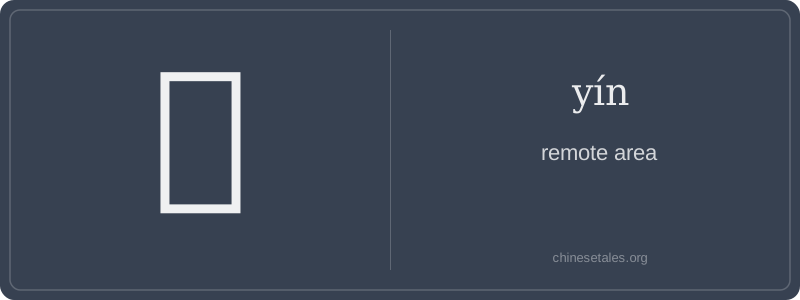
The character 殥 does not appear in oracle bone or bronze inscriptions — it’s a later creation, first reliably attested in the Shuōwén Jiězì (c. 100 CE). Its structure reveals its intent: the left radical ⺈ (a variant of 亠, representing 'cover' or 'top') sits above 今 (jīn, 'now'), and below that, a simplified form of 冖 (mì, 'covering cloth') fused with 乚 (yǐn, a hook suggesting concealment). Visually, it’s a layered enclosure — like 'now' sealed under cover, hidden from view. Over centuries, strokes condensed: the top became ⺈, the middle 今 lost its bottom horizontal stroke for elegance, and the lower part evolved into the curved 乚 + dot, symbolizing something veiled and inaccessible.
This visual logic directly shaped its meaning: 'what is concealed *now* — hence, out of reach, beyond the horizon, uncharted'. In classical texts like the Yùdì Zhì (Geographic Treatise of the Hàn Shū), 殥 appears to describe southern commanderies considered 'beyond the pale' of Han administration. Its semantic path wasn’t geographical alone — it extended metaphorically to 'obscure' (as in 殥奥 yín ào — profound and obscure meaning) and 'reclusive' (as in 殥士 yín shì — a secluded scholar). The character thus embodies a core Chinese cultural tension: the center versus the periphery, clarity versus mystery — all packed into seven strokes of deliberate concealment.
Imagine you’re hiking deep in the Wuyi Mountains, far from any village — no cell signal, no road, just mist-wrapped cliffs and silence so thick you hear your own breath. That’s the feeling of 殥 (yín): not just 'remote', but *profoundly* distant — geographically, culturally, even existentially. It’s not a casual 'far away' like 远 (yuǎn); it carries literary weight, evoking isolation, frontier obscurity, or the edge of known civilization. You’ll almost never hear it in daily speech — it lives in classical poetry, historical texts, or formal essays describing borderlands or forgotten hamlets.
Grammatically, 殥 is almost always an adjective modifying nouns (e.g., 殥地 yín dì — remote land), rarely used predicatively (*'This place is 殥'* sounds archaic and unnatural). It never stands alone as a noun or verb — unlike 远, which can be a predicate ('很远'), 殥 demands a noun partner. A common learner mistake? Using it where 远 or 偏僻 (piān pì) would fit better: saying '我家很殥' is jarringly poetic — like calling your suburban apartment 'a hermitage on the Silk Road’s outer rim'.
Culturally, 殥 echoes ancient Chinese cosmology: the center (中原 Zhōngyuán) was civilization; everything beyond — especially southward into mountainous, non-Han regions — was 殥. It’s subtly hierarchical, carrying faint connotations of 'uncivilized' or 'unassimilated'. Modern usage leans neutral or even romantic (e.g., praising ecological purity of 殥境), but the classical residue remains — making it a linguistic time capsule of imperial worldview.