殪
Character Story & Explanation
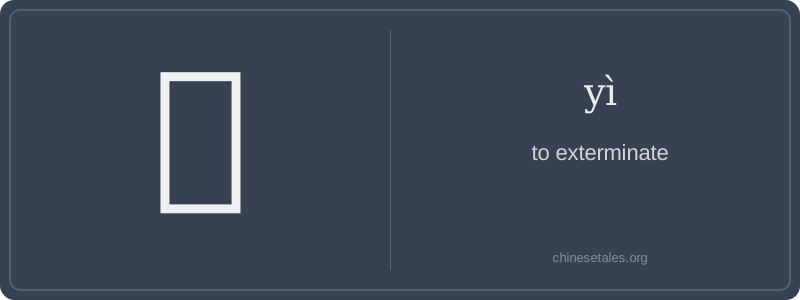
The earliest form of 殪 appears in Warring States bamboo slips as a combination of 歹 (a stylized skeleton or decaying corpse) and 益 (yì, originally depicting water overflowing from a vessel — later borrowed for sound). In oracle bone script, 歹 was a stark, angular depiction of bones scattered on ground — no flesh, no life, only aftermath. Over centuries, the ‘bone’ radical hardened into its current left-side shape, while the right side evolved from 益’s complex water-and-vessel structure into today’s streamlined 12-stroke form, retaining just enough curves to echo ‘overflowing’ — but now signifying ‘overflowing death’, i.e., total annihilation.
This semantic shift — from ‘overflow’ to ‘exterminate’ — reflects ancient Chinese cosmology: when moral order overflows its bounds (like floodwaters), chaos must be utterly quelled. The *Zuo Zhuan* (c. 4th century BCE) uses 殪 to describe Duke Huan of Qi’s decisive slaying of traitors — not mere execution, but ritual erasure. Later, in Tang dynasty poetry, 殪 appears in battlefield laments: ‘The fallen horses lie slain, their riders silent’ — the character visually enacts stillness: the dead radical anchors the bottom half, while the upper strokes seem to collapse inward, like a body folding into final rest.
At its core, 殪 (yì) isn’t just ‘to exterminate’ — it’s the visceral, final silence after violence: the collapse of breath, the stillness of absolute termination. It carries the grim weight of the 歹 (dǎi) radical — literally ‘corpse’ or ‘death’ — which appears in characters like 死 (sǐ, to die) and 残 (cán, cruel), always signaling irreversible loss. Unlike generic verbs like 消灭 (xiāomiè) or 清除 (qīngchú), 殪 is literary, often archaic or rhetorical, evoking moral gravity or cosmic retribution — think of a tyrant ‘exterminated by heaven’ (天诛地灭), not a software bug being ‘fixed’.
Grammatically, 殪 functions almost exclusively as a transitive verb, usually in formal or classical syntax — rarely in casual speech or modern compound verbs. You’ll find it in passive constructions (被…所殪), causative patterns (殪之), or tightly packed four-character idioms. Learners mistakenly try to use it like 杀 (shā, to kill), but 殪 implies totality and finality: killing one soldier is 杀; annihilating an entire rebel army at dawn is 殪. It’s never used for abstract concepts like ‘eradicating poverty’ — that’s 消除 or 根除.
Culturally, 殪 appears most vividly in classical military texts and historical novels (e.g., *Romance of the Three Kingdoms*), where heroes ‘slay the enemy general in single combat’ — not just defeat, but obliterate presence. A common pitfall? Confusing it with 易 (yì, easy) due to identical pinyin and visual similarity in cursive script — a slip that turns ‘the bandits were exterminated’ into ‘the bandits were easy’, causing delightful confusion. Also, never use it without clear agency: 殪 lacks the neutrality of 灭; it demands a doer — divine, heroic, or merciless.