氅
Character Story & Explanation
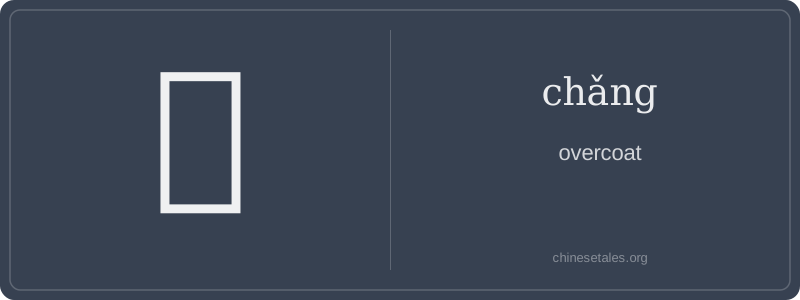
The earliest trace of 氅 appears not in oracle bones but in early clerical script (lìshū), where it emerges as a deliberate compound: the radical 毛 (‘hair’ or ‘fur’) on the left, and 昌 (chāng, ‘prosperous, radiant’) on the right. 昌 itself was originally two suns stacked — symbolizing brightness and abundance — but here it serves phonetically (chǎng sounds close to chāng) *and* semantically: a fine fur-lined coat *radiates* status and refinement. Stroke by stroke, the left side solidifies into the six-stroke 毛, while the right evolves from 昌’s dual 日 into its modern 8-stroke form — 6 + 8 = 14… wait, but 氅 has 16 strokes! Ah — the two extra strokes are the subtle hooks added to the top of 昌 in regular script to distinguish it from similar forms, turning elegance into precision.
By the Wei-Jin period, 氅 had crystallized as 鶴氅 (hè chǎng) — the legendary 'crane-feather cloak' worn by literati like Wang Xizhi’s circle, symbolizing purity, transcendence, and scholarly grace. In the *Shishuo Xinyu* (A New Account of the Tales of the World), a man wearing a 鶴氅 walks through snow, his robe billowing like wings — no wind needed. The character’s shape mirrors that image: 毛 suggests soft, drifting fur; 昌 suggests luminous, upright poise. It’s not just clothing — it’s embodied metaphor.
At first glance, 氅 looks like a fancy coat draped over something furry — and that’s *exactly* what it is. Its core meaning is 'overcoat' or 'long outer robe', but not just any coat: historically, it evokes a loose, flowing, often fur-trimmed garment worn by scholars, recluses, or Daoist immortals — think flowing sleeves, quiet dignity, and a whiff of mountain mist. It’s not casual wear; it’s literary attire, carrying poetic weight and an air of cultivated detachment.
Grammatically, 氅 is almost always a noun and appears in formal or literary contexts — you won’t hear it on the subway or in a café. It rarely stands alone; instead, it shows up in compounds like 鶴氅 (crane-feather cloak) or 氍毹氅 (a rare variant for stage costume). Unlike common clothing words like 衣 or 袍, 氅 never takes aspect markers (了, 过) or modifiers like 很 or 非常 — it resists colloquialization. Trying to say 'I wore a 氅 yesterday' with standard verb patterns feels jarringly archaic unless you’re quoting Tang poetry.
Culturally, this character is a time capsule: its presence signals classical allusion, not modern utility. Learners often misread it as a variant of 常 (cháng) due to the shared sound and visual similarity — but that’s a semantic chasm: one means 'often', the other means 'robe'. Worse, some assume it’s related to 毛 (hair/fur), which *is* true etymologically — but 氅 isn’t about hair *on the body*, it’s about hair *on the garment*. That fur trim? Not decoration — it’s the very reason the character was built around 毛.