氍
Character Story & Explanation
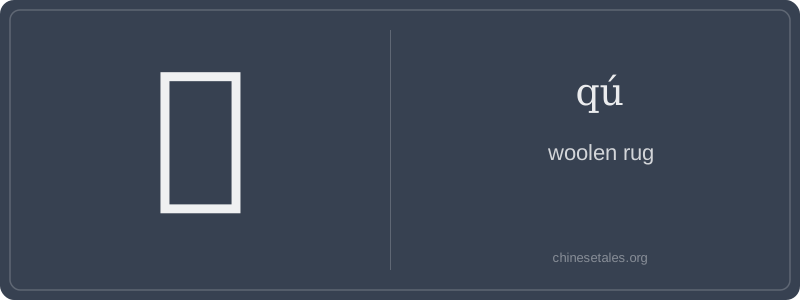
The earliest trace of 氍 lies not in oracle bones — too late for that — but in early clerical script (lìshū) from the Han dynasty. Its left side, 毛 (máo), is unmistakable: the ‘hair/fur’ radical, drawn with three downward strokes representing tufts — a visual anchor for anything fibrous or animal-derived. The right side, 蕖 (qú), is more intriguing: originally a phonetic component borrowed from 蕖 (lotus root), but re-purposed here purely for sound. Over centuries, scribes condensed 蕖’s complex structure — grass radical (艹), water (氵), and fish (魚) — into today’s tight, 22-stroke form, where the ‘fish’ at the bottom now looks like a stylized curl of wool thread.
By the Tang and Song dynasties, 氍 appeared in texts describing tribute goods: Tibetan envoys presenting ‘qú rugs’ woven with yak wool and indigo-dyed patterns. In Ming-Qing literature, 氍毹 emerged as a fixed compound — the rug beneath actors’ feet became synonymous with performance itself. Pu Songling used it in *Strange Tales* to evoke theatrical illusion, while modern poets like Xu Zhimo called the stage ‘the crimson 氍毹’, linking texture, color, and artistry in one resonant stroke.
At first glance, 氍 (qú) feels like a relic — not just because it’s absent from the HSK lists, but because its very shape whispers of imperial courts and nomadic trade routes. It means 'woolen rug' — specifically thick, patterned, handwoven rugs historically imported from Tibet and Central Asia. Unlike generic terms like 地毯 (dìtǎn), 氍 carries connotations of luxury, craftsmanship, and cultural exchange; it’s the kind of rug you’d find under a Qing dynasty emperor’s throne or draped over a Mongolian yurt’s central pillar.
Grammatically, 氍 is almost never used alone — it’s a bound morpheme, appearing only in compounds like 氍毹 (qú shū) or 氍毹上 (qú shū shàng). You’ll never say *‘this is a qú’* — instead, it’s embedded: ‘the stage (氍毹) was silent’ or ‘a figure appeared on the 氍毹’. Learners often mistakenly treat it as a standalone noun or confuse its tone (qú, second tone, not qǔ or qū), leading to mispronunciation that sounds like ‘cherry’ or ‘bent’ — hilariously off-target for a woolen rug.
Culturally, 氍 is deeply tied to Chinese opera — where 氍毹 became poetic shorthand for ‘the stage’ itself, evoking the red woolen rug laid before the performance area. This metaphorical leap (rug → stage → theatrical world) is classic classical Chinese wordplay: concrete object → elegant abstraction. Modern writers still use 氍毹 poetically, but most native speakers encounter it only in literary or historical contexts — making it a quiet time capsule of textile history and performing arts.