氐
Character Story & Explanation
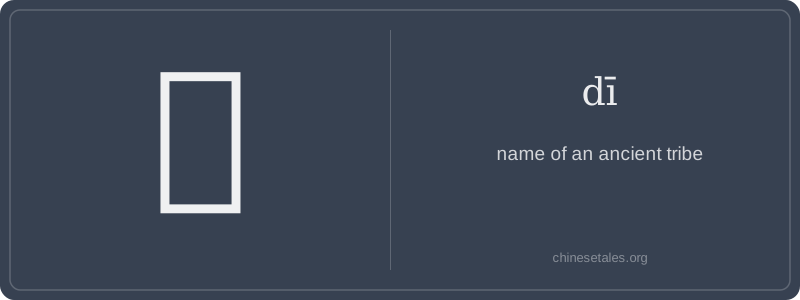
The earliest form of 氐 appears on Warring States bamboo slips as a simplified variant of 氏 — itself originally a pictograph of a ceremonial axe or banner pole, symbolizing authority and lineage. Early inscriptions show 氐 with four strokes: a horizontal line (一), a vertical line (丨), a left-falling stroke (丿), and a distinctive dot (丶) placed *below* the main structure — unlike 氏, where the dot sits *inside* or *above*. This lower dot wasn’t decorative; it was a deliberate diacritical mark added during the Qin standardization to distinguish the tribal name from the homophonous clan marker. By the Han dynasty, the five-stroke form stabilized: 丶 (dot), 一 (horizontal), 丿 (left-fall), ㇀ (rising stroke), and 乚 (curved hook) — each stroke now a silent witness to bureaucratic precision.
Over time, 氐’s meaning narrowed from a broader term for 'local peoples of the west' to refer specifically to the Dī — an agro-pastoral group speaking a Tibeto-Burman language, famed for cavalry and fortress-building. The Records of the Grand Historian (《史记》) mentions them alongside the Qiang and Xiongnu, while Tang poets like Du Fu allude to 'Dī dust' (氐塵) evoking the arid western marches. Visually, that lone dot beneath the rest feels like a root anchoring the character to the land — fitting for a people whose identity was inseparable from the Loess Plateau and Wei River valley.
Think of 氐 (dī) like the 'Celtic tribes' of ancient China — not a word you’d hear in daily conversation, but one that pulses with deep historical gravity. It refers specifically to the Dī people, a prominent non-Han ethnic group active in northwestern China from the Warring States through the Northern and Southern Dynasties (4th–6th c. CE). Unlike common nouns, 氐 almost never stands alone; it’s always part of proper nouns — tribal names, place names, or historical titles — much like how English uses 'Gaul' or 'Visigoth' only in scholarly or historical contexts, never as verbs or adjectives.
Grammatically, 氐 functions exclusively as a noun component — never a verb, adjective, or classifier. You’ll see it in compounds like 氐族 (Dī zú, 'the Dī people') or in classical texts such as the Book of Jin (《晋书》), where it appears in phrases like '氐帥' (Dī shuài, 'Dī chieftain'). Learners sometimes misread it as 氏 (shì, 'clan name') due to identical appearance except for the dot — a tiny stroke that changes everything: no dot = clan; dot below = ancient tribe. That dot is your historical GPS marker.
Culturally, 氐 carries subtle political weight: the Dī founded the Former Qin dynasty (351–394 CE), whose ruler Fu Jian nearly unified China — making 氐 not just ethnographic trivia, but a key to understanding early medieval power shifts. Mistake the dot, and you erase centuries of frontier history — confusing 'tribal leader' with 'family patriarch' isn’t just inaccurate, it flattens a vibrant, militarized, bilingual society into a bureaucratic footnote.