氕
Character Story & Explanation
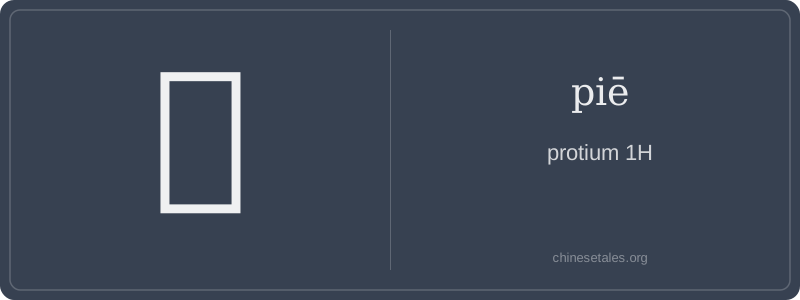
The character 氕 has no ancient origin — it was designed in 1955 by the Committee for the Reform of Chinese Characters, explicitly to represent the hydrogen-1 isotope. Its form is deliberately synthetic: the top half is the standard ‘gas’ radical 气 (four strokes, representing vapor or breath), while the bottom stroke — a single horizontal line — is a radical innovation: it stands for ‘one’, symbolizing the single proton (and zero neutrons) that define protium. Unlike oracle bone scripts carved into turtle shells or bronze inscriptions cast in ritual vessels, 氕 was drafted with a fountain pen on graph paper — a clean, rational stroke added to an existing radical to encode atomic number, not cosmology.
This makes 氕 a linguistic paradox: a fully orthodox-looking hanzi that breaks every rule of historical evolution. It wasn’t born from pictographic shorthand or phonetic loan; it was engineered. There are *no* classical references — no mentions in the *Shuōwén Jiězì*, no appearances in Tang poetry or Ming novels. Its entire semantic life began in a Beijing metrology lab. Visually, that lone horizontal stroke isn’t decorative — it’s a data point: one proton, one electron, one identity. In this sense, 氕 is less a ‘character’ than a typographic isotope label — a quiet, five-stroke manifesto of scientific modernity written in ink, not blood or bronze.
At first glance, 氕 looks like a tiny, humble character — just five strokes, built on the ‘qi’ (gas/vital energy) radical 气. But don’t let its simplicity fool you: this is not a classical word at all. It’s a 20th-century scientific coinage — one of only a handful of Chinese characters invented *after* 1949 specifically for nuclear chemistry. Its core meaning is precise and narrow: protium, the most common hydrogen isotope (¹H), with one proton and zero neutrons. In Chinese, it carries no poetic resonance, no idiomatic warmth — it’s strictly lab-coat vocabulary. You’ll never hear it in conversation, poetry, or even most textbooks; it appears only in advanced physics journals, nuclear engineering specs, or isotopic nomenclature charts.
Grammatically, 氕 functions exclusively as a noun, always paired with other isotopic characters like 氘 (deuterium) and 氚 (tritium). It never takes aspect markers (了, 过), doesn’t pluralize, and isn’t modified by adjectives — it’s a lexical unit, not a grammatical building block. Learners sometimes mistakenly treat it like a regular character and try to use it in compound verbs (e.g., *氕化*), but no such word exists — the correct term for 'hydrogenation' uses 氢, not 氕. Also, beware tone: it’s piē (first tone), not pī or pǐ — mispronouncing it risks sounding like ‘pee’ or ‘blow’, which is awkward in any context.
Culturally, 氕 embodies modern China’s linguistic pragmatism: when science demanded precision, linguists didn’t borrow a Greek letter — they forged a new hanzi. Its creation reflects a fascinating moment where traditional script met quantum physics. Still, its obscurity is absolute: even many native scientists say 氢-1 instead of 氕 in speech. So while it’s ‘real’ and officially encoded (Unicode U+6C15), it’s essentially a fossilized technical glyph — elegant, rare, and utterly unspoken.