氮
Character Story & Explanation
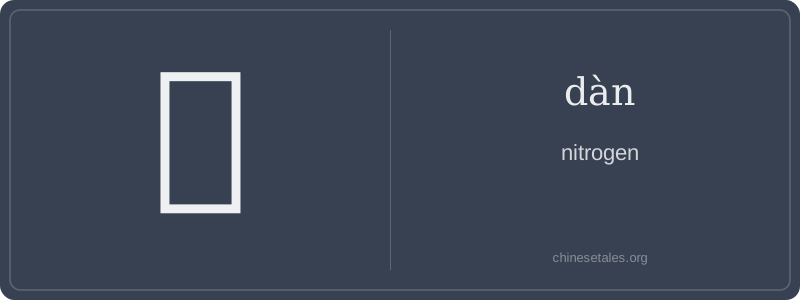
The character 氮 didn’t exist before the Qing dynasty. No oracle bones, no bronze inscriptions — it’s a deliberate neologism. Its creator, chemist Xu Shou, borrowed the existing character 淡 (dàn), meaning 'pale' or 'weak', and replaced its water radical (氵) with the gas radical (气) to visually signal 'a gaseous substance that behaves faintly' — reflecting nitrogen’s low reactivity. Stroke by stroke: start with 气 (6 strokes: floating vapor), then add the remaining 6 strokes of 淡 minus 氵 — essentially grafting the phonetic-semantic core onto the elemental category.
This wasn’t poetic invention — it was precision engineering. In classical texts, 淡 described taste or emotion; here, it was repurposed with scientific intent. The choice of 淡 wasn’t arbitrary: early Western descriptions noted nitrogen’s 'inertness' — like something diluted beyond action. By the 1930s, 氮 appeared in standardized chemistry textbooks, and today, it’s indispensable in agriculture (nitrogen fixation), medicine (liquid nitrogen), and climate science (N₂O emissions) — a quiet testament to how Chinese script adapts without losing its structural logic.
氮 (dàn) is a modern scientific character — born in the 19th century to translate Western chemistry — and it wears its purpose on its sleeve: the top radical 气 (qì, 'vapor' or 'gas') instantly signals it belongs to the gaseous elements, while the bottom component 淡 (dàn, 'pale', 'dilute', 'weak') serves double duty as both phonetic clue (sharing the same pronunciation dàn) and semantic hint: nitrogen is colorless, odorless, and chemically inert — literally 'pale' in reactivity. Unlike ancient characters with layered cultural metaphors, 氮 is refreshingly literal and functional.
Grammatically, 氮 never stands alone in speech or writing — you’ll almost always see it inside compounds like 氮气 (dànqì, 'nitrogen gas') or in technical contexts: lab reports, fertilizer labels, or environmental science texts. It’s a noun-only element; no verbs, no adjectives, no colloquial slang. Learners sometimes mistakenly treat it like a standalone word ('I need nitrogen!'), but native speakers would say 我需要氮气 (wǒ xūyào dànqì) or specify the compound — using just 氮 sounds like quoting a periodic table aloud.
Culturally, this character embodies China’s rapid adoption of Western science: created by scholars like Xu Shou in the 1860s–70s, it follows the 'gas + phonetic' pattern used for all elemental gases (e.g., 氧 yǎng 'oxygen', 氢 qīng 'hydrogen'). A common mistake? Confusing it with 淡 (dàn, 'bland') — same sound, same bottom half, but missing the vital 气 radical. That slip turns 'nitrogen deficiency' into 'bland deficiency' — scientifically meaningless and mildly culinary.