汝
Character Story & Explanation
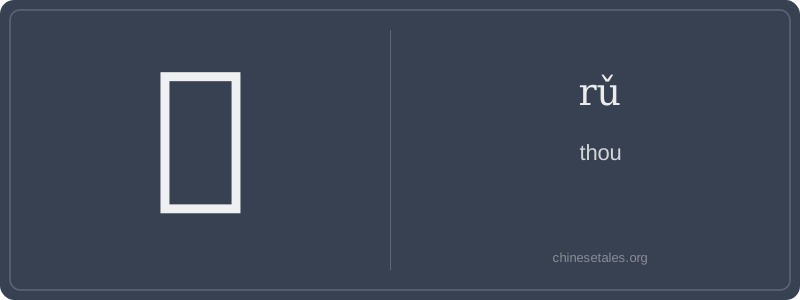
The earliest form of 汝 appears on Warring States bamboo slips as a flowing, water-like glyph with a phonetic element '女' (nǚ) on the right and three wavy strokes (like 氵) on the left — no rigid separation yet. Those three strokes weren’t just decorative; they were a pictograph of rippling water, hinting at fluidity, receptivity, even emotional depth. Over centuries, the water radical standardized into the modern 氵 (three dots), while the 'female' component solidified into 女 — but crucially, this wasn’t about gender: '女' here served purely as a *sound clue* for rǔ (both share an ancient -u rhyme), not a semantic one.
By the Han dynasty, 汝 was firmly established in texts like the Classic of Filial Piety, where Confucius uses it to address his disciples intimately: 'rǔ yì zhī zāi?' ('Do you also know this?'). Its visual duality — water (fluid connection) + 'nǚ' (sound anchor) — subtly reinforced its function: a pronoun that flows *between* people, not just naming them. Even today, calligraphers emphasize the contrast: the soft, curving 氵 versus the upright, grounded 女 — a perfect visual metaphor for respectful yet warm address.
汝 (rǔ) is the classical Chinese second-person singular pronoun — think Shakespearean 'thou' or German 'du': intimate, archaic, and dripping with literary weight. It’s not a word you’ll hear in Beijing street chats or HSK dialogues; it lives in ancient texts, poetic invocations, and solemn declarations — like a silk robe folded carefully in a museum case. Its core vibe is *familiar yet formal*, often signaling deep personal address (to a close friend, lover, or disciple) or reverent self-reference (e.g., 'your humble servant').
Grammatically, 汝 functions exactly like modern 你 — subject, object, possessive (汝之 = 'thy/thine') — but its usage is tightly bound by register. You’d never say 'rǔ yào chī fàn ma?' ('Do you want to eat?') to your roommate — that’s jarringly theatrical. Instead, it appears in fixed classical patterns: 汝其… ('May you…'), 汝安否? ('Are you well?'), or as a rhetorical device in essays to evoke gravity. Learners sometimes overuse it thinking it sounds 'more authentic' — a classic faux pas that makes native readers blink twice.
Culturally, 汝 carries subtle hierarchy: in Confucian texts, elders or sages use it to juniors, implying benevolent authority — not condescension, but care-laced responsibility. It also appears in Buddhist sutras (e.g., 'rǔ dāng zhī' — 'you should know') to signal direct transmission of wisdom. A common mistake is confusing it with 女 (nǚ, 'woman') — same top component, but radically different meaning and tone. Remember: 汝 isn’t outdated; it’s *curated*. It’s the difference between texting 'hey' and writing a love letter in calligraphy.