汞
Character Story & Explanation
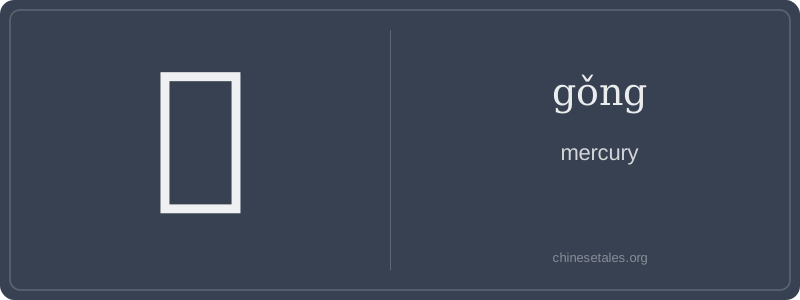
The earliest form of 汞 appears in Han dynasty seal script, where it fused two ideas: the left side 氵 (a simplified 水 radical, three dots representing flowing water) and the right side 工 (gōng), originally a pictograph of a carpenter’s square — symbolizing precision, craft, and *control*. Over time, 工 evolved into the modern shape you see today: seven clean strokes, with the water radical anchoring the bottom-left and 工 sitting upright, almost like a tiny instrument measuring something volatile. This wasn’t arbitrary — alchemists needed exact proportions when mixing cinnabar (HgS) to extract mercury, so 工 subtly encoded the idea of calibrated transformation.
In classical texts like the *Baopuzi* (c. 320 CE), mercury was called 靈砂 (língshā, 'spirit sand') and linked to yin-yang balance — its fluidity (yin) and metallic luster (yang) made it the ultimate mediator between states of matter. The character 汞 itself first appeared in Tang dynasty medical manuals as shorthand for this elusive substance. Visually, the contrast between the soft, curving water radical and the rigid, angular 工 mirrors mercury’s own contradiction: endlessly mobile, yet unchangeably elemental — a liquid that refuses to become solid, and a metal that refuses to stay still.
汞 (gǒng) isn’t just the chemical name for mercury — it’s a linguistic fossil of Chinese alchemy and cosmology. Unlike English, which borrows ‘mercury’ from Roman mythology, Chinese named this silvery, restless liquid metal 汞 because it *flows like water* (hence the 水 radical) yet *shines like metal* — and its ancient name 水銀 (shuǐyín, 'water-silver') reveals how early Chinese observers prioritized behavior over composition. The character feels cool, heavy, and slightly dangerous — a vibe that sticks in technical and environmental contexts today.
Grammatically, 汞 is almost always a noun and rarely stands alone; it appears in compounds or after measure words like 一滴 (yī dī, 'a drop') or 一克 (yī kè, 'one gram'). You’ll almost never say *‘gǒng shì…’* (‘mercury is…’) without context — instead, it’s embedded: 汞含量 (gǒng hánliàng, 'mercury content'), 汞蒸气 (gǒng zhēngqì, 'mercury vapor'). Learners often wrongly treat it as a verb or try to use it with aspect particles like 了 — but 汞 doesn’t ‘do’ anything; it *is*, and it *leaks*.
Culturally, 汞 carries centuries of paradox: revered in Daoist elixirs for immortality, then feared as a poison that killed emperors (like Qin Shi Huang). Modern usage reflects that duality — it appears in both high-tech LED manufacturing and public health warnings about contaminated fish. A common mistake? Confusing it with 洪 (hóng, 'flood') — same radical, totally different sound and meaning. Remember: 汞 is *silent, silver, sinister* — not roaring water.