沂
Character Story & Explanation
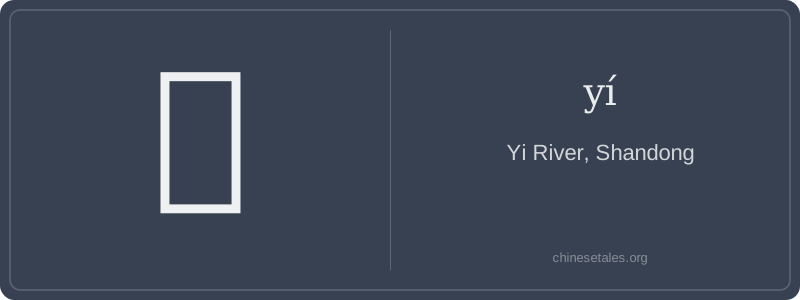
The earliest form of 沂 appears in Warring States bamboo slips (c. 475–221 BCE), not oracle bones — it’s too specific a local name to appear in early divination inscriptions. Its structure was already stable: three dots of water (氵) on the left, and on the right, a simplified form of 坒 — a character originally depicting a mound or ridge (like 山 + 土), later repurposed purely for sound. In bronze script, the right side resembled a hill with a horizontal stroke across its peak, suggesting elevation beside water — fitting, since the Yi River flows through hilly terrain in Shandong. Over centuries, the mound shape streamlined into today’s 坒: a vertical line, two short horizontals, and a final downward stroke — seven strokes total, clean and rhythmic.
Its meaning never strayed: always the river’s name. Unlike many characters whose meanings broadened (e.g., 江 once meant only the Yangtze), 沂 stayed fiercely local. In the Classic of Poetry and Sima Qian’s Records of the Grand Historian, it appears solely as a toponym — often paired with nearby landmarks like 蒙山 (Meng Mountain), forming the enduring regional label 沂蒙. The visual pairing of water + ridge also subtly reflects the river’s real geography: it rises in the Meng Mountains and winds through foothills — so the character isn’t just phonetic; it’s a tiny landscape sketch in ink.
沂 (yí) is a proper noun character — it’s not a verb, adjective, or abstract concept, but a geographical name first and foremost: the Yi River in southeastern Shandong Province. Its core identity is anchored in place — think of it like ‘Thames’ or ‘Mississippi’ in English: you don’t use it alone to mean ‘river’ (that’s 河), and you never say ‘I yí-ed the bridge’ — it simply *is* the river’s name, embedded in history and terrain. Visually, it’s built from 氵 (the water radical, always on the left in characters related to liquids or rivers) plus 坒 (yí), which here serves phonetically — it tells you how to pronounce it, not what it means. So this is a classic xíngshēng (phonosemantic) character: water + sound.
Grammatically, 沂 appears almost exclusively in fixed proper nouns — place names, surnames, or classical allusions. You’ll see it in terms like 沂蒙 (Yíméng, the mountainous region around the Yi River) or as a rare surname (e.g., 沂先生). Learners sometimes mistakenly treat it as a generic word for ‘river’ and try to pair it with verbs like 流 (flow) or 汇 (converge); that’s unnatural. Native speakers wouldn’t say *沂流* — they’d say 沂河 (Yí Hé) if specifying ‘Yi River’, because 河 is required for clarity. Also, note: it’s tone 2 (yí), not yì or yǐ — mispronouncing it risks confusion with words like 宜 (suitable) or 已 (already).
Culturally, 沂 carries quiet weight: the Yi River basin is part of the cradle of Confucian culture — just north of Qufu, where Confucius lived. It appears in the Analects (11.26) in the famous ‘Yi River bathing’ passage, where Confucius and his disciples discuss ideals by the riverbank — a poetic symbol of harmony and self-cultivation. Because it’s not in HSK, learners rarely encounter it outside geography texts or classical readings — making it a subtle marker of deeper cultural literacy. A common mistake? Writing it as 宜 (yí, ‘suitable’) by accident — same sound, totally different meaning and shape!