沄
Character Story & Explanation
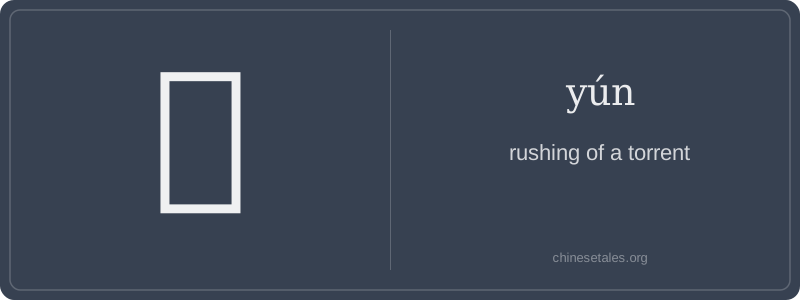
The earliest form of 沄 appears in seal script (c. 3rd century BCE), built from the water radical 氵on the left — three flowing dots representing ripples — and 云 (yún, 'cloud') on the right. This wasn’t arbitrary: ancient scribes saw clouds gathering over mountains as the source of torrents — mist condensing, rain swelling streams, and rivers surging forth with cloud-like turbulence. The right side isn’t just phonetic; it’s semantic synergy: clouds move swiftly and unpredictably, just like a churning current. Over centuries, the water radical simplified from 水 to 氵, and 云 retained its graceful, curving strokes — giving modern 沄 its elegant asymmetry: fluid left, airy right.
This dual origin shaped its literary destiny. In the Chu Ci (Songs of Chu, 3rd c. BCE), 沄 appears in lines describing the Xiang River’s 'yun yun' surge — not merely fast, but mysteriously deep and resonant. Later, poets like Li Bai used 沄 to suggest inner turmoil mirroring nature’s power. Crucially, its shape *mirrors* its meaning: the three water dots ripple downward like cascading foam, while the 云 component curves upward like mist rising from the rapids — a perfect visual paradox of water moving both down and up, chaos and grace entwined.
First, let’s feel 沄 — it’s not just ‘rushing water’; it’s the visceral, almost musical roar of a torrent churning with turbulence and momentum. Think white-water rapids in a narrow canyon: chaotic, powerful, and deeply rhythmic. Unlike generic words like 水 (shuǐ, 'water') or 流 (liú, 'to flow'), 沄 carries poetic weight — it’s onomatopoeic in spirit, evoking the low, guttural rush you hear before you see the current. Native speakers don’t use it in daily chat ('I’ll get water' → never 沄); it lives in classical poetry, literary descriptions, and names.
Grammatically, 沄 is almost always a noun or a descriptive noun modifier — rarely a verb. You’ll see it in phrases like 沄沄 (yún yún), where reduplication intensifies the sense of ceaseless, swirling motion. It never stands alone as a verb ('to rush') — that’s 流 or 奔. A classic mistake? Using 沄 where 晕 (yūn, 'dizzy') or 云 (yún, 'cloud') fits phonetically but semantically fails — tone and shape matter! Its 'yún' sound is shared with several characters, so learners must anchor meaning to its water radical and turbulent visual rhythm.
Culturally, 沄 appears in Tang and Song dynasty poetry to convey emotional unrest or cosmic flux — water as metaphor for life’s uncontrollable force. Modern usage is rare but potent: it shows up in place names (e.g., rivers in Guangdong) and personal names (often chosen for its lyrical resonance and auspicious 'flow' symbolism). Don’t memorize it for conversation — learn it to read Du Fu’s river metaphors or to appreciate why a poet chose 沄 over 波 or 涛.