沘
Character Story & Explanation
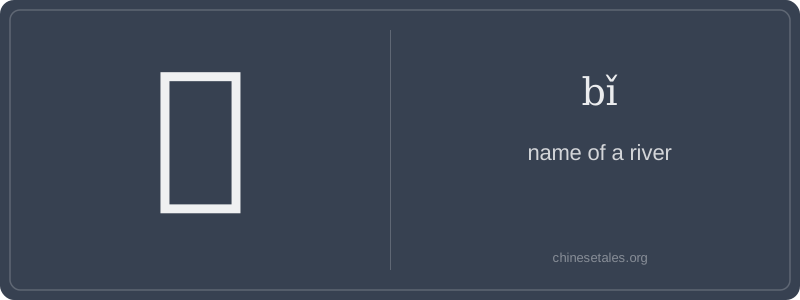
The earliest form of 沘 appears in Han dynasty bamboo slips and seal script as a flowing water radical (氵) on the left, paired with 比 — which at the time resembled two people facing each other, arms bent, suggesting likeness or proximity. In oracle bone script, there was no standalone 沘; it emerged later as a phonosemantic compound, borrowing 比’s pronunciation (bǐ) while anchoring it to water. Over centuries, the three-dot water radical stabilized, and 比 simplified from its dual-figure bronze form into today’s clean, symmetrical strokes — two parallel ‘l’-shaped marks, like ripples frozen mid-current.
Historically, 沘 referred specifically to a tributary of the Han River in ancient Hubei — mentioned once in the *Shui Jing Zhu* (Commentary on the Water Classic, 6th c. CE) as 沘水, describing its confluence with the main river. Unlike generic terms like 溪 (xī, ‘stream’) or 港 (gǎng, ‘harbor’), 沘 never broadened semantically; it stayed pinned to that one watercourse, like ‘Styx’ clinging to Greek myth. Its visual stillness — balanced, mirrored strokes — ironically contrasts its real-world function: a dynamic, merging boundary between waters.
Think of 沘 (bǐ) like the 'Nile' or 'Thames' in English — not a generic word for 'river' (that’s 河 hé), but a proper name carved into geography and history. It’s a rare, literary river-name character, almost never used in daily speech or modern writing — more like encountering 'Avon' in Shakespeare than 'river' in a weather report. You won’t hear it on Chinese TV or see it on subway maps; it lives in classical texts, local gazetteers, and the names of ancient waterways.
Grammatically, 沘 functions exclusively as a noun — always capitalized in effect, though Chinese has no capital letters. It never takes measure words, doesn’t combine freely with verbs like ‘flow’ or ‘cross’, and absolutely cannot be pluralized or modified with adjectives like ‘big’ or ‘polluted’. Trying to say ‘the polluted 沘 River’ would sound as jarring to a native speaker as saying ‘the polluted Thames Thames’. Its usage is fossilized: it appears only in fixed place names (e.g., 沘水 Bǐ Shuǐ), often paired with 水 (shuǐ, ‘water’) to form a full hydronym.
Culturally, 沘 embodies how Chinese treats geography like genealogy — rivers are ancestors, not resources. Learners often mistakenly assume it’s a general term and try to use it like 河 or 江, leading to unintentionally poetic (and confusing) errors. Another trap: misreading its radical as 氵 (water) alone — but look closer: it’s actually 氵 + 比, where 比 carries phonetic weight, not meaning. This isn’t ‘comparing rivers’ — it’s pure sound symbolism from ancient dialects.