沽
Character Story & Explanation
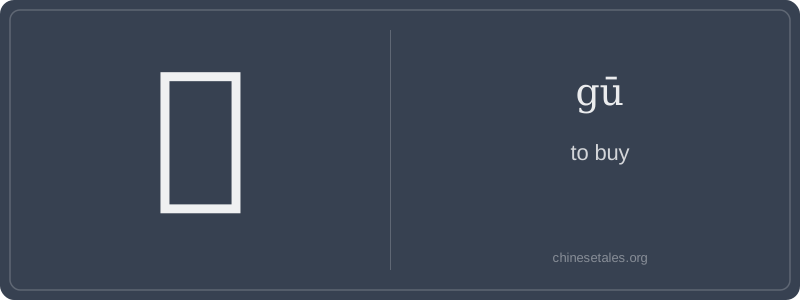
The earliest form of 沽 appears in bronze inscriptions as a combination of 氵 (water) and 古 (ancient/gǔ). The 古 component wasn’t just phonetic — it originally depicted an ancient vessel or ritual object, suggesting something venerable, established, or traded in traditional markets. Over time, the 古 evolved from a pictograph of a drum-shaped container into today’s simplified form, while the three-dot water radical remained consistent, anchoring the character to riverine trade routes. By the Han dynasty, the seal script version already resembled modern 沽 — compact, balanced, and unmistakably rooted in commerce near waterways.
Its meaning crystallized around the Warring States period, appearing in texts like the Guoyu (Discourses of the States) to describe acquiring goods — especially grain or salt — at regulated markets near rivers. Later, in the Tang and Song dynasties, 沽 expanded metaphorically: to 'buy' reputation (沽名), favor (沽恩), or even time (沽誉). The water radical subtly reinforced this — just as rivers carry goods, so too do transactions carry value, influence, and risk. Even today, when Tianjin locals call their city 'Jīn Gū', they’re invoking over two millennia of commerce flowing through its ports.
At first glance, 沽 (gū) feels like a quiet, old-fashioned cousin of the more common 买 (mǎi, 'to buy') — and that’s exactly right. It carries a distinct literary and commercial flavor: think merchants haggling at a dockside market, not grabbing groceries at a supermarket. Its core meaning is 'to buy' (especially in formal, classical, or regional contexts), but crucially, it almost never stands alone as a verb in modern spoken Mandarin — you’ll rarely hear someone say '我沽了一本书' in casual chat. Instead, it shines in fixed compounds and set phrases, often with a tone of deliberation, negotiation, or even irony.
Grammatically, 沽 functions mainly in two ways: as part of verbs like 沽名 (gū míng, 'to seek fame') — where it means 'to acquire' metaphorically — or in commercial terms like 待沽 (dài gū, 'awaiting sale'). Notice how it flips direction: while 买 always means 'to buy', 沽 can mean 'to buy' *or* 'to sell' depending on context and compound! In classical usage and certain dialects (like Tianjin slang), 沽 can mean 'to sell' — yes, the same character! Learners often trip here, assuming it only means 'buy' and misreading sentences like '此画待沽' ('This painting is awaiting sale') as 'awaiting purchase'.
Culturally, 沽 breathes the air of old China’s mercantile hubs — especially the port city of Tianjin, historically called 'Jīn Gū' (津沽), where 沽 became a poetic name for the city itself. That’s why it appears in names like 沽源 (Gūyuán, a county in Hebei). Mistake alert: don’t substitute it for 买 in daily speech — native speakers will notice instantly. And remember: its water radical (氵) isn’t about liquids — it’s a clue to its origin as a place name tied to rivers and docks.