泂
Character Story & Explanation
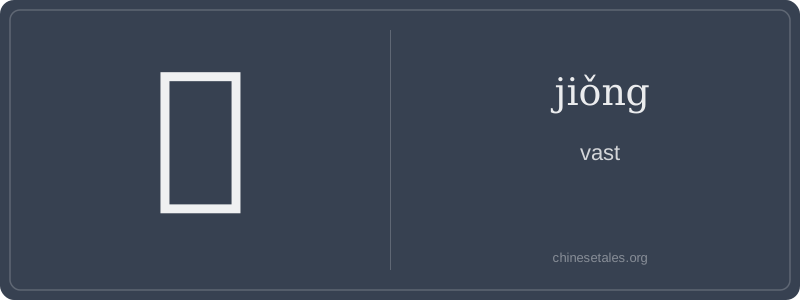
The earliest form of 泂 appears in Warring States bamboo slips as a stylized pictograph: three horizontal lines (representing water or horizon) beneath a simplified ‘冋’ (jiǒng), which itself evolved from oracle bone inscriptions depicting a walled enclosure with an open gateway — symbolizing boundless space beyond the walls. Over time, the water radical 氵 (three dots) replaced the full ‘水’ component, while the phonetic ‘冋’ stabilized into its modern form, preserving both the visual suggestion of flowing openness and the ancient sense of spatial infinity.
This character’s meaning never wavered: from bronze inscriptions describing ‘the 泂 wilderness beyond the borders’ to Du Fu’s Tang dynasty line ‘天泂数万里’ (‘Heaven’s vastness stretches ten thousand li’), 泂 consistently conveyed awe-inspiring, unconfined expanse — not emptiness, but fertile, dynamic openness. Its structure — water flowing outward from an open gate — is a masterclass in semantic-phonetic fusion: the 氵 hints at fluid continuity, while 冋 (pronounced jiǒng) anchors the sound and deepens the idea of ‘beyond the known perimeter.’
Think of 泂 (jiǒng) as Chinese poetry’s version of the word 'vast' — not just big, but *cosmically* open: imagine standing alone on a windswept steppe at dawn, where sky and land blur into one endless, breath-catching expanse. That’s 泂 — it evokes immensity with quiet solemnity, rarely used in casual speech but deeply cherished in literary and classical contexts for its lyrical weight and visual elegance.
Grammatically, 泂 is almost always an adjective, typically appearing in fixed literary compounds (like 泂然 or 泂阔) or as a standalone descriptive term in poetic lines. You won’t hear it in ‘The weather is 泂 today’ — it doesn’t pair with 是 or 很 like modern adjectives; instead, it appears pre-nominally (泂数千里) or post-verbally in classical syntax (‘目极泂数千里’ — ‘eyes gaze across vast thousands of li’). Learners often mistakenly try to use it predicatively or with 很 — a red flag that instantly marks non-native phrasing.
Culturally, 泂 carries Daoist and early cosmological resonance: it’s tied to the primordial void before creation, echoing in texts like the Zhuangzi where ‘泂数万里’ describes the unbounded realm of the Dao. Its rarity in spoken Mandarin means encountering it feels like finding a sealed scroll — rewarding only if you pause to savor its shape, sound, and silence. Don’t force it into conversation — let it bloom in writing, poetry, or when describing landscapes that steal your breath.