泐
Character Story & Explanation
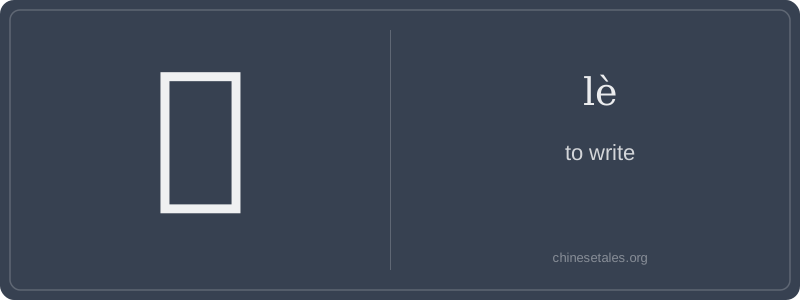
The earliest form of 泐 appears in Warring States bronze inscriptions as a composite glyph: a stylized hand holding a writing tool (often resembling a knife or brush) above a surface — sometimes with three dots representing ink droplets or characters being formed. Over time, the hand morphed into the left-hand component (which later standardized as 氵, the water radical — reflecting ink’s fluid nature), while the right side solidified into 刋 (kè), a phonetic and semantic element meaning 'to cut' or 'engrave', emphasizing incision rather than surface marking.
This evolution mirrors how Chinese writing itself shifted from carving oracle bones to brushing silk — yet 泐 retained its association with enduring inscription. In the Shuōwén Jiězì (121 CE), Xu Shen defined it as 'to carve characters onto stone or metal', citing its use in imperial edicts and ancestral temple inscriptions. Even today, when a historian says 泐于竹简 ('inscribed upon bamboo slips'), they’re invoking not just literacy, but the physical labor and spiritual weight behind recording truth for posterity.
Think of 泐 not as a generic 'write' like English 'write', but as the precise, almost ritualistic act of inscribing characters onto bamboo slips or oracle bones — like a scribe etching sacred text into stone with a chisel. Its core meaning is 'to write' in the sense of deliberate, permanent inscription, not casual note-taking. You’ll rarely hear it in modern spoken Mandarin (hence its absence from HSK), but it lives on in literary, historical, and bureaucratic contexts — think official documents, stele inscriptions, or classical poetry where every stroke carries weight.
Grammatically, 泐 is a transitive verb and usually appears in formal or compound constructions: 泐名 (lè míng, 'to inscribe one’s name'), 泐石 (lè shí, 'to engrave stone'). It does NOT take aspect particles like 了 or 过 freely — saying *我泐了* sounds archaic or jarringly poetic. Instead, you’d say 他已泐于碑上 ('He has already been inscribed upon the stele'), using passive or prepositional phrasing. Learners often mistakenly use it like 写 (xiě), but 泐 implies solemnity, permanence, and sometimes even commemoration — writing that’s meant to last centuries.
Culturally, 泐 evokes China’s deep reverence for written language as an act of memory, authority, and immortality. Mistaking it for 写 is like confusing 'engrave' with 'scribble' — same action, wildly different gravity. Also beware: its water radical (氵) isn’t about liquid, but about the 'flow' of ink or the 'moisture' needed for ink to adhere — a subtle semantic nuance lost on beginners.