植物
How to Understand
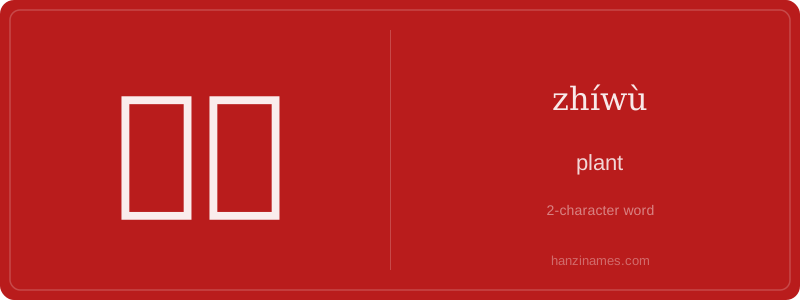
植物 (zhíwù) refers to a plant, typically a living organism that grows in the ground and is not an animal. It can also be used more broadly to refer to any form of vegetation, including trees, flowers, and grasses. Unlike 'tree' (树, shù), which specifically means a large woody plant, 植物 is a general term for all types of plants.
The character 植 (zhí) originally meant 'to plant' or 'to grow upright,' and 物 (wù) means 'thing' or 'object.' Together, they form a word that literally translates to 'upright-growing thing,' emphasizing the vertical growth of plants. This etymology reflects the ancient Chinese view of plants as standing tall and growing from the earth.
植物 is commonly used in everyday language, especially in contexts related to nature, biology, and gardening. In scientific discussions, it may also refer to the kingdom Plantae. Understanding 植物 is essential for anyone interested in Chinese botany, ecology, or environmental studies.