物
Character Story & Explanation
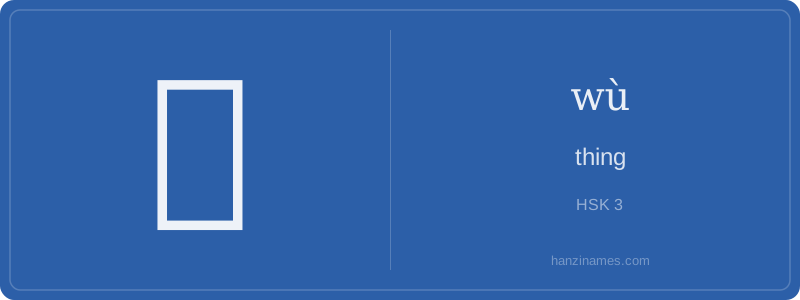
物 is ubiquitous in daily Chinese: from supermarket signs (商品, shāngpǐn — 'commercial goods') to legal documents (物品, wùpǐn — 'articles/property'). It appears in foundational idioms like 万物更新 (wàn wù gēng xīn, 'all things renew')—used during Spring Festival to express hope for transformation. Historically, 物 was central to Warring States philosophy; Mencius used 萬物 (wàn wù) to argue that humans share moral sprouts with all things.
The character’s form evolved from seal script: the left side 牛 (ox) originally represented an animal head (a common radical for livestock-related terms), while the right side 勿 (wù) served phonetically. Though not a pictograph, its structure reflects early Chinese categorization—things vital to survival (like oxen) formed the semantic core for 'thing' itself.
The character 物 (wù) embodies the Chinese philosophical understanding of 'thing' not as inert matter, but as a node in dynamic relational networks—echoing Daoist and Confucian views where every 'thing' gains meaning through context, function, and interdependence. Its radical 牛 (niú, 'ox') hints at ancient agrarian roots: early 'things' were often livestock or agricultural essentials—living, useful, and socially embedded.
In classical texts like the Dao De Jing, 物 appears in phrases like 'the ten thousand things' (萬物, wàn wù), signifying the teeming, ever-changing manifestations of the Dao—not passive objects, but active participants in cosmic flow. This reflects a worldview where ontology is relational, not atomistic: a 'thing' exists *because* of its place in patterns of use, change, and harmony.
Even today, 物 resists reduction to mere 'object'. In modern Mandarin, it carries subtle ethical weight: 'material things' (物質, wùzhì) are contrasted with 'spiritual matters' (精神, jīngshén), echoing centuries-old debates about desire, moderation, and authenticity. To call something a 物 is to acknowledge its tangibility—but also to invite reflection on its role in human life and moral cultivation.
Example Sentences
Common Compounds
Similar Characters — Don't Mix These Up
Your First Step into Chinese Culture: Get a Chinese Name
Every journey into Chinese begins with a name. Use our free Chinese name generator to create a meaningful, personalized Chinese name that fits you perfectly.
Get My Chinese Name →