了
Character Story & Explanation
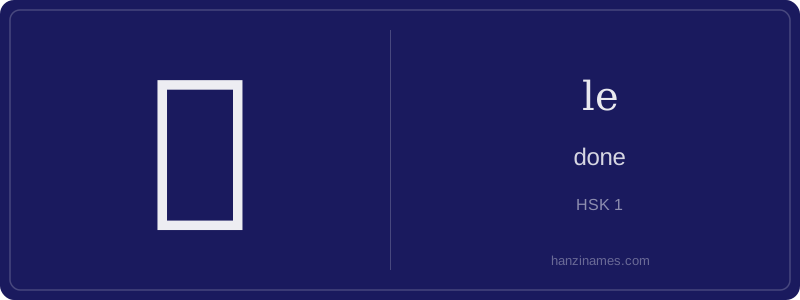
了 is indispensable in daily Mandarin: it appears in >95% of spoken sentences describing completed actions (e.g., '我吃了' — 'I ate') and new situations ('下雨了' — 'It started raining'). Documented since the Han dynasty in texts like the *Shuōwén Jiězì* (121 CE), it was classified as a 'final particle' (語末助詞). Its use in classical poetry and vernacular novels (e.g., *Dream of the Red Chamber*) confirms its grammatical stability for over 1,800 years.
The character’s form has no pictographic origin—it is a stylized derivative of the ancient character (liǎo), meaning 'to finish', simplified over centuries. Its two-stroke shape (亅 + 乚) emerged definitively in clerical script (Lìshū) during the Han dynasty. Today, Chinese learners first encounter it in HSK 1 dialogues—e.g., '我明白了' ('I understand now')—where it signals cognitive completion, not just physical action.
As an archaeologist sifting through layers of linguistic sediment, I uncover 了 not as a fossilized relic—but as a living grammatical artifact still actively reshaping meaning. Its earliest attested forms in Warring States bamboo slips (4th–3rd c. BCE) show it functioning not as a verb, but as a sentence-final particle marking narrative completion—like sealing a clay tablet with a final impression. This functional ‘stamp’ predates its modern grammatical dominance by over two millennia.
The character’s minimalist form—just two strokes—belies its profound syntactic weight. Unlike pictographic characters carved from observation, 了 evolved through phonetic loan and grammaticalization: originally a verb meaning ‘to finish’ or ‘to end’ (now obsolete in that sense), it was repurposed as a bound morpheme. Its radical 亅 (‘hook’) hints at its syntactic role—hooking the verb to the temporal frame of the utterance, anchoring action in completed time.
Excavating modern usage reveals how deeply 了 is embedded in Mandarin’s temporal architecture. It doesn’t merely signal past tense—it marks *aspect*: the boundary between ‘before’ and ‘after’, expectation and realization. In spoken discourse, its omission or insertion can shift meaning from hypothetical to factual, from habitual to punctual. Like a subtle stratigraphic marker, 了 tells us not *when*, but *that* change has irrevocably occurred.
Example Sentences
Common Compounds
Similar Characters — Don't Mix These Up
Your First Step into Chinese Culture: Get a Chinese Name
Every journey into Chinese begins with a name. Use our free Chinese name generator to create a meaningful, personalized Chinese name that fits you perfectly.
Get My Chinese Name →