是
Character Story & Explanation
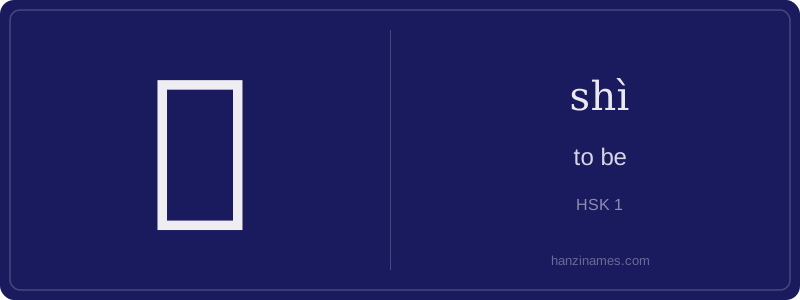
是 is indispensable in modern Mandarin: it appears in over 95% of beginner textbooks and ranks among the top 10 most frequently used characters in written Chinese (per the 2020 Modern Chinese Corpus). It anchors common phrases like 是的 (shì de, 'yes'), 是不是 (shì bu shì, 'is it or isn't it?'), and idioms like 实事求是 (shí shì qiú shì, 'seek truth from facts')—a key principle in Chinese policy since the 1940s. Official documents, news headlines, and daily chats rely on 是 for clarity and affirmation.
The character’s earliest verified form appears in Warring States bamboo slips (475–221 BCE) as a compound of 日 ('sun', symbolizing clarity/truth) and 止 ('to stop', later evolving into the lower component). Scholars agree the original sense was 'to be correct' or 'to match reality'—hence its semantic shift to 'to be' as a marker of factual alignment. No oracle bone form survives, but its consistency across 2,300+ years confirms deep linguistic stability.
是 (shì) is one of the most essential characters in Chinese—it’s the verb 'to be' used to affirm identity, state, or truth. Unlike English, Chinese doesn’t conjugate verbs, so 是 stays the same regardless of subject: I am, you are, she is—all use 是. It’s never used for temporary states (like 'I am tired')—those require adjectives with 很 or other structures. Mastering 是 helps you form basic declarative sentences and yes/no questions.
Remember: 是 only links nouns, pronouns, or noun phrases—not adjectives or verbs directly. So 'He is a teacher' = 他是老师 (tā shì lǎoshī), but 'He is tall' = 他很高 (tā hěn gāo), *not* 他是高. Also, 是 is omitted in present-tense 'have' constructions (e.g., 我有书, not 我是有书). Its simplicity hides important grammatical boundaries beginners must learn early.
At HSK Level 1, 是 appears constantly—in introductions, descriptions, and corrections. You’ll see it in patterns like 是…的 (shì…de) for emphasis ('It was *him* who did it'), though that’s HSK 2+. For now, focus on core affirmative use: Subject + 是 + Noun/Phrase. Practice writing it stroke-by-stroke, paying attention to the 日 (rì, 'sun') radical at the top—it’s your anchor for recognition and recall.
Example Sentences
Common Compounds
Similar Characters — Don't Mix These Up
Your First Step into Chinese Culture: Get a Chinese Name
Every journey into Chinese begins with a name. Use our free Chinese name generator to create a meaningful, personalized Chinese name that fits you perfectly.
Get My Chinese Name →