在
Character Story & Explanation
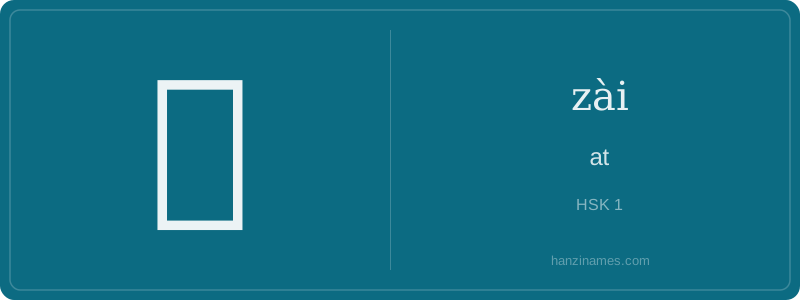
在 is among the most frequently used characters in modern Mandarin—appearing in daily speech, digital communication, official documents, and HSK-1 textbooks. It’s indispensable in locative phrases (e.g., 在学校 zài xuéxiào 'at school') and progressive constructions (e.g., 在吃饭 zài chīfàn 'eating right now'). A common idiom is 正在…呢 (zhèngzài…ne), emphasizing immediacy ('I’m just… right now'). Historically, 在 appears in early classical texts like the *Zuo Zhuan* (4th c. BCE) meaning 'to reside' or 'to be present,' retaining its core locative sense across 2,500 years.
The character’s form is not pictographic but phono-semantic: 土 (tǔ, 'earth/soil') is the semantic radical, indicating relation to place or ground; 至 (zhì, 'to arrive') is the phonetic component (though pronunciation has shifted). No oracle bone or bronze script form survives for 在—the earliest attested form is in Warring States bamboo slips (c. 4th–3rd c. BCE), already with the current structure.
The Chinese character 在 (zài) is a foundational grammatical particle in Mandarin, primarily functioning as a verb meaning 'to be located at' or 'to exist in a place or state.' Unlike English verbs such as 'to be,' which conflate existence, identity, and location (e.g., 'I am happy,' 'She is a teacher,' 'They are here'), 在 exclusively marks *location* or *ongoing action*—never identity or permanent attributes. Its use is mandatory in locative constructions: you cannot say 'I home' in Chinese—you must say 'I 在 home' (wǒ zài jiā). This grammatical precision reflects a linguistic worldview where spatial and temporal grounding is syntactically foregrounded.
In Western thought—especially in Cartesian or Aristotelian traditions—existence ('to be') is often abstract and metaphysical (e.g., 'I think, therefore I am'). In contrast, 在 anchors being firmly in concrete, observable reality: one *is* only by virtue of being *somewhere* or *in some ongoing process*. This echoes classical Chinese philosophical emphasis on relationality and situatedness over essentialist ontology. There’s no standalone 'being' without context—no 'zài' without a 'where' or 'when.'
Culturally, this mirrors Confucian and Daoist sensibilities: identity emerges from role and position (e.g., 'son at home,' 'teacher in classroom') rather than inner essence. A Western equivalent might be the German 'da sein' ('to be there')—but even that lacks 在’s grammatical indispensability. While English uses prepositions ('at,' 'in,' 'on') or auxiliaries ('am/is/are + -ing'), 在 uniquely merges locative marker and aspectual verb, making it both a spatial anchor and a temporal hinge for continuous action—a duality with no single English counterpart.
Example Sentences
Common Compounds
Similar Characters — Don't Mix These Up
Your First Step into Chinese Culture: Get a Chinese Name
Every journey into Chinese begins with a name. Use our free Chinese name generator to create a meaningful, personalized Chinese name that fits you perfectly.
Get My Chinese Name →