老子
How to Understand
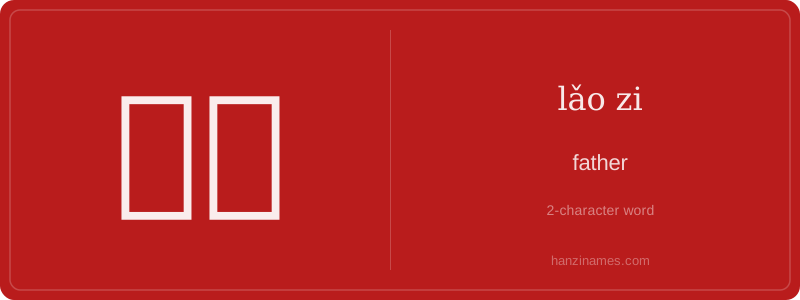
老子 (lǎo zi) is a term that literally translates to 'old man' or 'father.' It is often used as a humble or colloquial way to refer to oneself, especially in informal settings. In philosophical contexts, it can also refer to Laozi, the ancient Chinese philosopher and author of the Dao De Jing.
The character 老 (lǎo) means 'old' or 'elderly,' while 子 (zǐ) is a suffix often used to denote a person, similar to '-son' or '-child' in English. Together, they form a term that can be both literal and symbolic, depending on context.
While 老子 is commonly translated as 'father,' it is more accurately used as a self-referential term meaning 'old man' or 'my father.' It is not typically used to address someone else directly but rather to describe oneself in a modest or humorous tone. In literature and philosophy, it is also associated with the legendary figure Laozi, an important figure in Daoism.