子
Character Story & Explanation
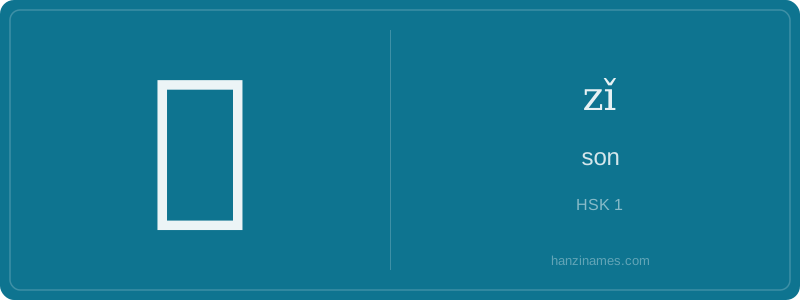
子 appears ubiquitously in modern Chinese: as a standalone noun ('son'), in kinship terms (儿子 érzi 'son', 女儿 nǚ'ér 'daughter'), and as a diminutive suffix (花儿 huār → 花子 huāzi 'little flower', though more commonly in northern dialects). It’s central in idioms like 子虚乌有 (zǐxū wūyǒu, 'utterly fictitious'), referencing a fictional character from Han dynasty literature. Historically, it was among the earliest characters standardized under Qin script reforms and remains unchanged since seal script.
Archaeologically, 子 is a clear pictograph in oracle bone inscriptions (c. 1200 BCE): it depicts a child with large head and arms outstretched—emphasizing vulnerability and dependence. This visual origin directly supports its core meaning: a young male descendant requiring care, instruction, and inheritance—anchoring Chinese kinship structure and ritual practice for over three millennia.
The character 子 (zǐ) is far more than 'son'—it embodies the Confucian ideal of continuity, responsibility, and familial duty. In traditional Chinese thought, the son carries forward ancestral lineage, moral cultivation, and social role—not as an individualistic identity, but as a relational node in a web of filial piety (xiào), respect for elders, and intergenerational obligation. This reflects a worldview where personhood is defined through relationship and responsibility, not autonomy.
Historically, 子 also functioned as an honorific title for revered scholars and philosophers—Confucius (Kǒngzǐ), Mencius (Mèngzǐ)—signifying wisdom and moral authority. This dual usage—intimate family member and exalted sage—reveals how Chinese culture blurs the boundary between kinship and virtue: to be a true 'son' is to embody integrity, learning, and reverence. The character thus encodes ethical aspiration within domestic intimacy.
Even phonetically, the neutral tone variant 'zi' (e.g., in 桌子 zhuōzi 'table') shows how 子 evolved into a grammatical suffix denoting smallness, familiarity, or endearment—a linguistic softening that mirrors its cultural resonance: warmth, approachability, and grounded humanity. Its simplicity (just three strokes) belies profound depth: 子 is both origin and vessel—of life, language, and ethics—making it a cornerstone of Chinese semiotic and social architecture.
Example Sentences
Common Compounds
Similar Characters — Don't Mix These Up
Your First Step into Chinese Culture: Get a Chinese Name
Every journey into Chinese begins with a name. Use our free Chinese name generator to create a meaningful, personalized Chinese name that fits you perfectly.
Get My Chinese Name →