下
Character Story & Explanation
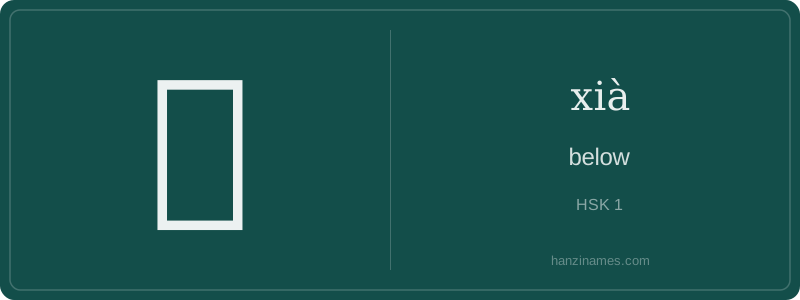
下 is ubiquitous in modern Chinese life: seen on elevator buttons (‘B1’ is 一楼下), subway signs (‘下一站’ – next stop), and digital interfaces (‘下载’ – download). It appears in the classic idiom 每况愈下 (měi kuàng yù xià, 'worsening progressively'), documented since the Song dynasty, and in formal writing like imperial edicts where 下旨 (xià zhǐ) meant 'to issue an imperial decree'—signifying authority descending from above.
Archaeologically, 下 first appeared in oracle bone script (c. 1200 BCE) as a horizontal line (一) with a dot or short stroke beneath it—clearly picturing 'that which is below the baseline'. This early form evolved into the modern three-stroke version: a top horizontal stroke (一), a left-falling stroke (丿), and a right-falling stroke (㇏), preserving its original positional logic.
The Chinese character 下 (xià) is one of the most foundational and frequently used characters in Mandarin—appearing in HSK Level 1, with just three simple strokes. Its core meaning centers on spatial or temporal orientation: 'below', 'down', 'under', or 'next' (as in 'next week'). Unlike English prepositions like 'under' or 'beneath', which are purely relational, 下 functions flexibly as a noun, verb, adjective, and directional complement—revealing how Chinese grammar encodes direction and sequence directly into single characters.
Western languages often rely on multi-word constructions to express what 下 conveys in one glyph: 'go down' (verb), 'the floor below' (noun), 'next chapter' (temporal), or 'under pressure' (prepositional). In contrast, 下 integrates these meanings seamlessly—highlighting a conceptual economy where position, motion, and sequence share the same root idea: descent or succession. This reflects a worldview where verticality (up/down) structurally organizes both physical space and time.
Culturally, 下 embodies humility and groundedness—values echoed in idioms like 虚心下气 (xūxīn xià qì, 'humble and gentle') and phrases like 下课 (xiàkè, 'dismiss class'), where 'going down' signifies respectful conclusion or yielding. Unlike Western metaphors that often associate 'up' with positivity ('upbeat', 'uplifted'), Chinese uses 下 not only for physical lowering but also for constructive transitions—e.g., 下载 (xiàzǎi, 'download') implies bringing knowledge *down* to the user, reinforcing accessibility over hierarchy.
Example Sentences
Common Compounds
Similar Characters — Don't Mix These Up
Your First Step into Chinese Culture: Get a Chinese Name
Every journey into Chinese begins with a name. Use our free Chinese name generator to create a meaningful, personalized Chinese name that fits you perfectly.
Get My Chinese Name →