能
Character Story & Explanation
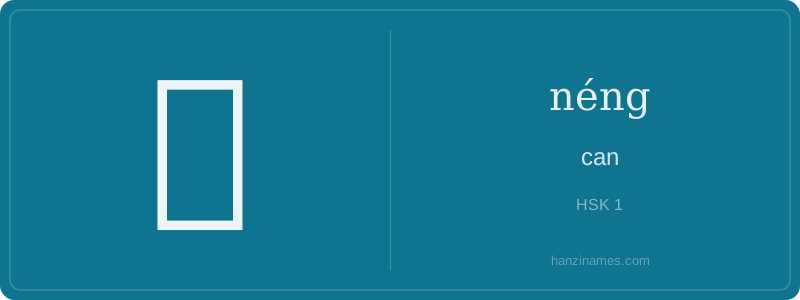
能 is ubiquitous in daily Chinese: from HSK-1 classroom drills ('You can speak Chinese!') to official documents ('The system can process 10,000 requests/sec'). It appears in core idioms like 无能为力 (wú néng wéi lì, 'powerless') and the classical phrase 能者多劳 (néng zhě duō láo, 'the capable bear more responsibility'), reflecting a long-standing societal expectation linking ability with duty. Its use in legal language (e.g., 民事行为能力, 'civil capacity') shows its formal, binding role in defining rights and responsibilities.
The character’s earliest attested form appears in bronze inscriptions of the Western Zhou dynasty (c. 1046–771 BCE), where it depicted a bear-like creature (熊) — symbolizing strength and endurance — later simplified and fused with the ⺼ radical. Though the bear element (⺈+匕+肉) became highly stylized, historical dictionaries like *Shuōwén Jiězì* (121 CE) confirm its origin in the concept of animal vigor and physical efficacy.
The character 能 (néng) embodies a deeply relational and contextual understanding of capability in Chinese thought—not as an isolated, innate trait, but as something contingent on conditions, effort, and harmony with circumstances. Unlike Western notions that often emphasize individual potential or fixed talent, 能 reflects Confucian and Daoist sensibilities: one 'can' only when aligned with virtue (德), timing (时), and environment (势). This frames ability as dynamic, earned, and ethically grounded.
Its radical ⺼ (‘meat’ or ‘flesh’) hints at embodied, lived competence—not abstract theory but physical, practical mastery. Historically, 能 appeared in classical texts like the *Zuo Zhuan* and *Mencius*, where it described rulers’ capacity to govern justly or scholars’ ability to cultivate moral character. Thus, 'can' is inseparable from responsibility and cultivation.
In modern usage, 能 retains this ethical weight: asking 'Can you help?' (你能帮忙吗?) implies not just skill, but willingness and appropriateness. Even in tech contexts—like AI systems described as 具备智能能力 (possessing intelligent capability)—the term carries expectations of reliability and social utility. To say 'I can' is to affirm readiness within a web of relationships, not merely declare personal power.
Example Sentences
Common Compounds
Similar Characters — Don't Mix These Up
Your First Step into Chinese Culture: Get a Chinese Name
Every journey into Chinese begins with a name. Use our free Chinese name generator to create a meaningful, personalized Chinese name that fits you perfectly.
Get My Chinese Name →