工
Character Story & Explanation
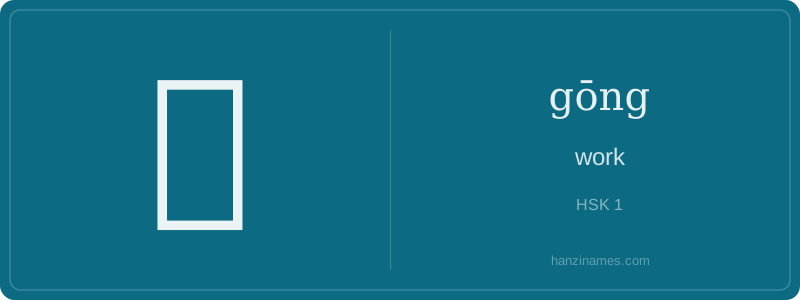
工 is ubiquitous in daily Chinese life: it appears on construction site signs (工地, gōngdì, 'construction site'), factory worker ID badges (工人证), and official documents like the 'Labor Contract Law' (劳动合同法). A well-known idiom is 工欲善其事,必先利其器 (gōng yù shàn qí shì, bì xiān lì qí qì)—'A craftsman wishing to do his work well must first sharpen his tools', quoting Confucius’ *Analects* 15.10, underscoring preparation and professionalism.
Archaeologically, 工 appears unchanged from early bronze inscriptions (c. 11th–3rd century BCE), where it pictographically represented a carpenter’s square—a T-shaped tool for measuring right angles. This documented origin reflects its enduring link to precision, structure, and skilled labor—not abstract labor, but calibrated, repeatable action.
The Chinese character 工 (gōng) is one of the simplest and most foundational characters in Mandarin—just three strokes, yet deeply embedded in language and culture. Unlike English 'work', which emphasizes effort or employment, 工 carries connotations of skilled craft, systematic labor, and functional precision. It appears in words ranging from 'worker' (工人) to 'engineering' (工程), reflecting China’s long-standing reverence for technical mastery and disciplined practice.
In classical usage, 工 denoted artisans—carpenters, masons, and metallurgists—who were highly respected in Zhou Dynasty society. This contrasts with Western pre-industrial views where manual labor was often socially subordinate. In modern China, 工 remains central to national discourse on productivity, vocational education, and technological self-reliance—evident in slogans like 'artisan spirit' (工匠精神), echoing Confucian ideals of moral cultivation through diligent practice.
Culturally, 工 resonates with Western concepts like 'craftsmanship' (German *Handwerk*) or 'ergon' (Greek for 'work' or 'function'), but differs in its lack of inherent moral duality—unlike English 'work', which can imply drudgery or virtue depending on context, 工 is neutral and structural. Its minimal form—a horizontal line, a vertical stroke, then another horizontal—mirrors architectural blueprints or engineering schematics, reinforcing its association with design, measurement, and reliability.
Example Sentences
Common Compounds
Similar Characters — Don't Mix These Up
Your First Step into Chinese Culture: Get a Chinese Name
Every journey into Chinese begins with a name. Use our free Chinese name generator to create a meaningful, personalized Chinese name that fits you perfectly.
Get My Chinese Name →