积
Character Story & Explanation
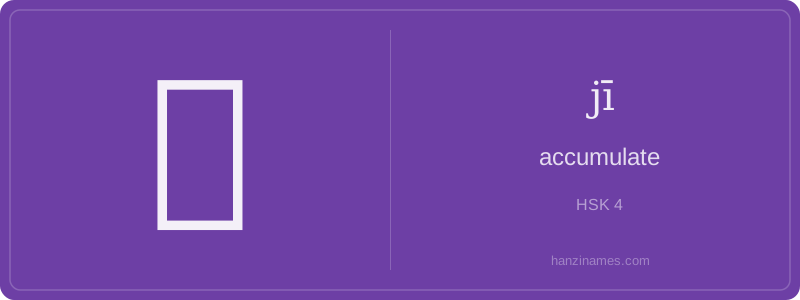
积 is ubiquitous in modern Mandarin: it appears in formal policy documents (e.g., 'accumulating ecological civilization achievements'), everyday apps (WeChat Pay's 'accumulated points' interface), and common idioms like 日积月累 (rì jī yuè lěi, 'daily accumulation, monthly buildup')—a phrase cited in classical texts like the *Xunzi* to describe how learning compounds over time. It’s also central to financial terms like 积金 (jī jīn, 'savings fund'), referencing China’s national housing provident fund system established in 1991.
The character’s form combines 禾 (hé, 'grain') on the left and 只 (zhǐ, archaic variant of 'to gather') on the right—documented in seal script inscriptions from the Warring States period (475–221 BCE). While not a pictograph, its structure visually reinforces the idea of storing harvested grain, reflecting early agricultural administration where surplus grain was systematically stockpiled for state stability.
The Chinese character 积 (jī) conveys the active, intentional process of gathering and storing—whether tangible things like grain or intangible assets like knowledge, experience, or merit. Unlike passive English verbs like 'collect', 积 implies sustained effort and purposeful buildup over time, often with long-term benefit in mind. Its禾 (grain) radical roots it in agrarian values: ancient Chinese society prized careful accumulation of harvests to survive winters and famines—a mindset that evolved into modern metaphors for learning and virtue.
In Western contexts, 'accumulate' or 'amass' carry neutral or sometimes negative connotations (e.g., 'amassing wealth' may suggest greed), whereas 积 is culturally neutral-to-positive, especially when paired with virtuous nouns: 积德 (jī dé, 'accumulate virtue') reflects Confucian and Buddhist ideals of moral capital earned through consistent good deeds. This reflects a deeper cultural emphasis on gradual, invisible growth—like composting soil—rather than sudden acquisition.
Western productivity culture often celebrates rapid results ('hustle', 'scale fast'), while 积 embodies patience and compounding returns—akin to compound interest in finance or deliberate practice in skill development. The HSK 4 placement signals its functional importance: learners need 积 to discuss education (积累经验 jīlěi jīngyàn, 'accumulate experience'), environmental issues (积雪 jīxuě, 'accumulated snow'), or even digital life (积攒积分 jīzǎn jīfēn, 'accumulate loyalty points'). Mastery of 积 unlocks nuanced expression of sustainable growth.
Example Sentences
Common Compounds
Similar Characters — Don't Mix These Up
Your First Step into Chinese Culture: Get a Chinese Name
Every journey into Chinese begins with a name. Use our free Chinese name generator to create a meaningful, personalized Chinese name that fits you perfectly.
Get My Chinese Name →