窗
Character Story & Explanation
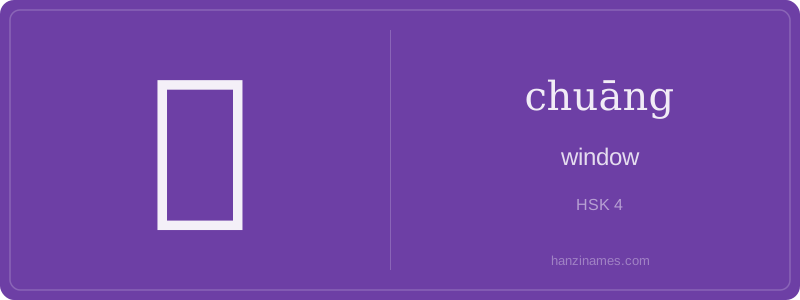
窗 appears in daily life from apartment listings (‘朝南的窗’ — ‘south-facing window’) to poetic idioms like ‘窗口单位’ (chuāngkǒu dānwèi), meaning ‘service-facing unit’—a bureaucratic term since the 1980s for frontline government offices, metaphorically ‘windows’ to public access. It’s central in classical poetry: Du Fu wrote of ‘窗含西岭千秋雪’ (‘Through my window, the snow-capped Xiling Mountains stretch across millennia’), highlighting its role as a framed view into nature and time.
The character’s earliest attested form appears in clerical script (Lishu) of the Qin–Han period—not oracle bone or bronze inscriptions. It’s a semantic-phonetic compound: 穴 (radical, meaning ‘opening in a structure’) + 叢 (phonetic component, historically approximating chuāng’s sound; its shape evokes lattice, consistent with archaeological finds of wooden window grilles at Mawangdui and Fenghuangshan tombs).
As an archaeologist brushing dust from a Han dynasty bamboo slip, I find 窗 not as a static symbol but a layered artifact: its upper component 穴 (xué, 'cavity' or 'cave') reveals ancient architecture—early dwellings carved into cliffs or earth banks, where openings were literal holes in the wall. This radical anchors the character in human shelter, long before glass or frames existed.
The lower part 叢 (cóng, 'thicket' or 'cluster') is key: it’s not merely decorative. In seal script, it evolved from pictographic elements suggesting latticework—interwoven wooden strips used in Zhou and Warring States windows for ventilation and light control while keeping out rain and intruders. This reflects sophisticated pre-modern material culture, documented in excavated lacquerware and architectural models.
Unlike Western ‘window’—derived from Old Norse ‘vindauga’ (‘wind-eye’)—窗 carries no optical metaphor. Its etymology is tactile and structural: a functional aperture defined by its boundary (穴) and its crafted infill (叢). Even today, when Chinese speakers say ‘open the window’, they invoke that ancient duality: breach the enclosure, yet maintain order through design.
Example Sentences
Common Compounds
Similar Characters — Don't Mix These Up
Your First Step into Chinese Culture: Get a Chinese Name
Every journey into Chinese begins with a name. Use our free Chinese name generator to create a meaningful, personalized Chinese name that fits you perfectly.
Get My Chinese Name →