童
Character Story & Explanation
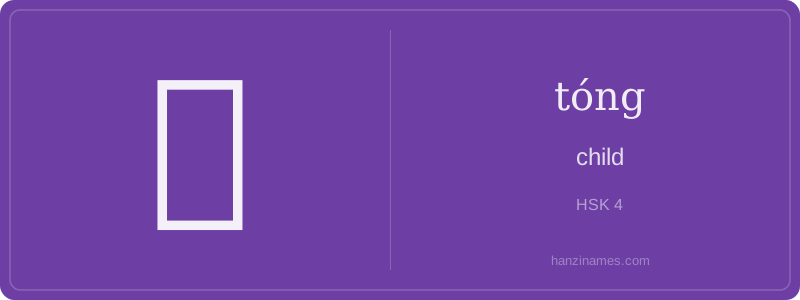
童 is widely used today in compound words like 童话 (tónghuà, 'fairy tale'), 童年 (tóngnián, 'childhood'), and 童工 (tónggōng, 'child labor')—the latter appearing in official reports and legal discourse since China’s 1991 Law on the Protection of Minors. It features in the national curriculum (HSK 4) and appears in idioms such as 金童玉女 (jīn tóng yù nǚ, 'golden boy and jade girl'), referencing auspicious celestial attendants in folk religion and wedding iconography.
The character’s earliest attested form appears in Warring States bamboo slips (c. 475–221 BCE) as a phono-semantic compound: the top 立 (lì) signals posture/standing presence, while the bottom 里 (lǐ, originally meaning 'village' or 'neighborhood') served phonetically. Though not a pictograph, its structure reflects social belonging—a child defined by communal role, not isolated biology.
The Chinese character 立 (lì, 'to stand') serves as the radical for 童 (tóng), visually anchoring the concept of a child in an upright, present, and socially recognized position. Unlike English 'child'—a neutral, age-based term—童 carries connotations of innocence, untutored purity, and cultural role: historically, it denoted youths serving in ritual or official capacities (e.g., 'page' or 'attendant'), not merely biological immaturity.
In classical texts like the *Analects*, 童 appears in phrases such as 童子 (tóngzǐ, 'youth') to describe morally formative stages of life, emphasizing education and ethical cultivation over chronological age. This reflects Confucian ideals where childhood is a preparatory phase for virtue—not a protected, autonomous stage as emphasized in modern Western developmental psychology.
Western equivalents like 'child', 'youth', or 'minor' are largely legal or biological categories; 童, by contrast, is deeply embedded in rites of passage and literary symbolism—think of the 'eternal child' motif in Taoist poetry or the revered '童心' (tóngxīn, 'childlike heart') in late-Ming philosophy, signifying uncorrupted authenticity. It’s less about dependency and more about moral potential and aesthetic sincerity.
Example Sentences
Common Compounds
Similar Characters — Don't Mix These Up
Your First Step into Chinese Culture: Get a Chinese Name
Every journey into Chinese begins with a name. Use our free Chinese name generator to create a meaningful, personalized Chinese name that fits you perfectly.
Get My Chinese Name →