笨
Character Story & Explanation
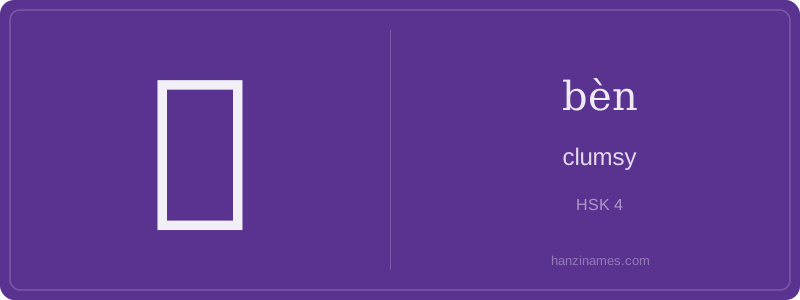
笨 is widely used in daily speech for gentle self-criticism or lighthearted teasing—e.g., ‘我太笨了,又忘了密码’ (‘I’m so dumb—I forgot my password again’). It appears in idioms like 笨鸟先飞 (bèn niǎo xiān fēi, ‘a slow bird takes flight early’), a proverb from the Ming dynasty text Expansion of the Classic of Filial Piety, praising diligence over natural talent. Historically, it was documented in the Shuōwén Jiězì (121 CE) as meaning ‘unskillful, lacking agility.’
The character’s structure combines ⺮ (bamboo) on top and 本 (běn, ‘root, origin’) below—a phono-semantic compound where 本 provides pronunciation and hints at ‘fundamental nature.’ Though not pictographic, this composition subtly reinforces the idea that ‘clumsiness’ stems from unrefined fundamentals—not moral failure—but can be reshaped through training and reflection.
The character 笨 (bèn) opens a window into the Chinese worldview where intelligence is not just cognitive but deeply relational and embodied. Unlike Western notions that often equate ‘stupid’ with fixed deficiency, 笨 carries connotations of clumsiness, slowness to grasp, or lack of social finesse—qualities seen as malleable through practice and humility. This reflects Confucian ideals: even ‘slow’ learners can cultivate virtue and skill with diligence (勤, qín), making 笨 less an insult than a diagnostic observation.
In classical texts, 笨 rarely appears as a moral condemnation; instead, it describes physical or procedural ineptitude—like a farmer struggling with new irrigation tools. Its bamboo radical (⺮) hints at structural rigidity: bamboo is strong yet inflexible, mirroring how ‘being 笨’ suggests resistance to adaptation rather than inherent incapacity. This nuance underscores a core Chinese belief: human potential unfolds through context, effort, and mentorship—not innate talent alone.
Modern usage reveals cultural self-awareness: young Chinese often call themselves 笨 in self-deprecating humor when failing at tech tasks or cooking, signaling modesty rather than despair. In education, teachers may say ‘你只是暂时笨一点’ (‘You’re just temporarily a bit slow’) to encourage growth mindset—a direct echo of the Mencian view that all people possess the ‘sprouts’ of virtue. Thus, 笨 is not a label but an invitation to try again, together.
Example Sentences
Common Compounds
Similar Characters — Don't Mix These Up
Your First Step into Chinese Culture: Get a Chinese Name
Every journey into Chinese begins with a name. Use our free Chinese name generator to create a meaningful, personalized Chinese name that fits you perfectly.
Get My Chinese Name →